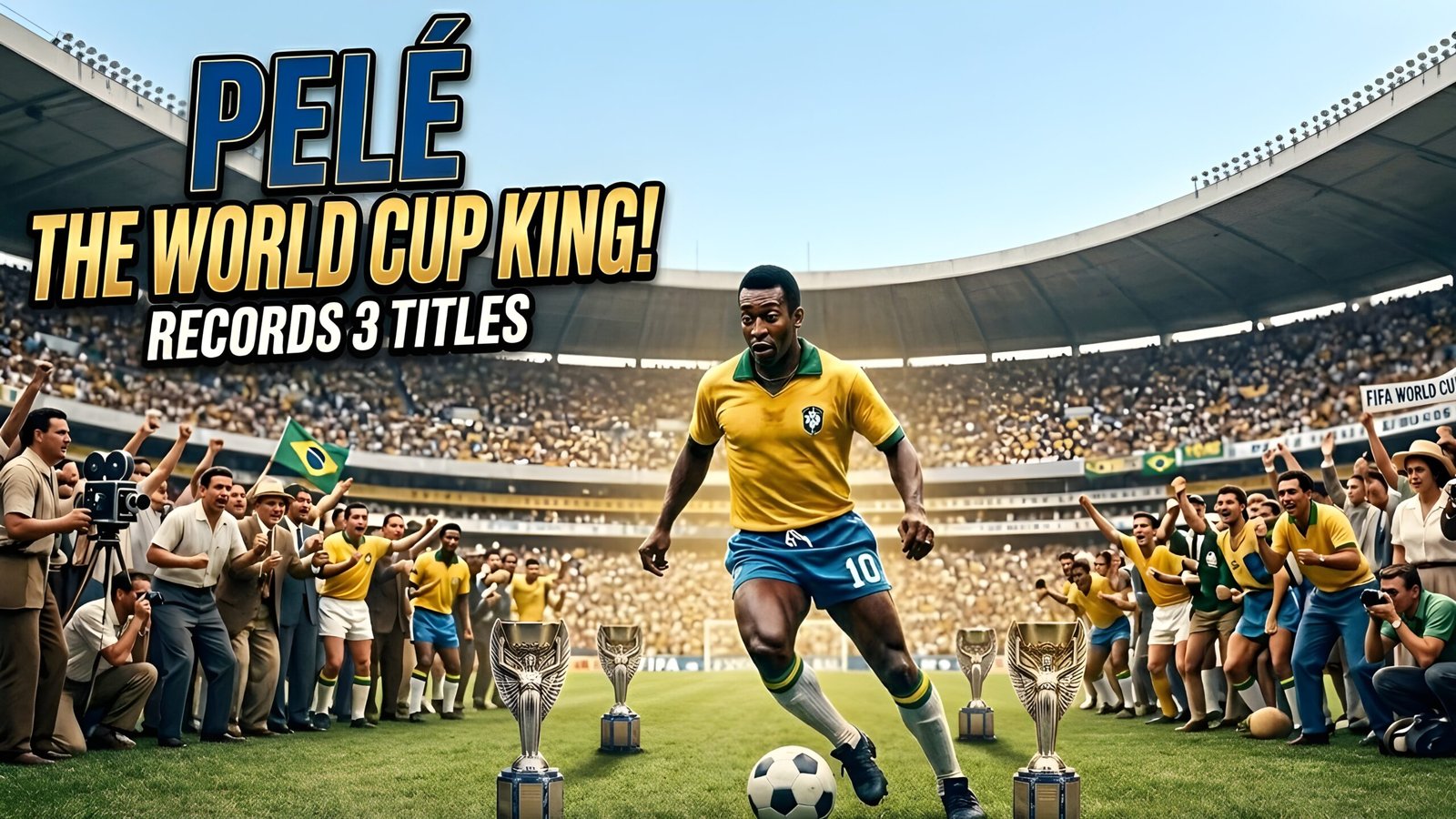
Why Pelé Is the Greatest FIFA World Cup Player of All Time
To understand why Pelé remains the greatest FIFA World Cup player of all time, one must look beyond statistics and trophies, into the soul of a competitor who redefined what a footballer could be.
Pelé’s unmatched World Cup legacy combines technical mastery, record-breaking triumphs, and transformative impact, setting him apart from all rivals. Across three tournaments and four decades of football history, one name resurfaces whenever the debate begins:
Edson Arantes do Nascimento — the man the world knows simply as Pelé. To understand why he remains the greatest FIFA World Cup player, one must look beyond statistics and trophies, into the soul of a competitor who redefined what a footballer could be on the grandest stage in sport.
What Makes Pelé’s Technical Skills Unrivalled?
When football historians debate who deserves the title of greatest FIFA World Cup player of all time, the conversation almost always begins with technical ability — and Pelé stands alone at that summit. His skill set was not merely exceptional; it was encyclopedic, a complete dictionary of football ability written in real time on the grandest stage.
Finishing and Aerial Dominance Under Pressure
Pelé was a finisher of rare two-footed quality. Whether the ball arrived on his preferred right foot or his equally lethal left, he struck with the same conviction and accuracy. In high-pressure World Cup moments — precisely when most players shrink — Pelé expanded.
His goal against Sweden in the 1958 final, a stunning chest-and-volley combination at just 17 years old, remains one of the most technically demanding finishes ever scored in World Cup history. That single moment encapsulated his ability to compose himself, control the ball in tight space, and deliver with clinical precision under the weight of a nation’s expectation.
His aerial game was equally formidable. Standing at 5’8″, Pelé compensated for his modest height with extraordinary timing and explosive leap. He attacked crosses with the authority of a much taller striker, winning aerial duels that opponents with physical advantages routinely lost.
In an era where set-pieces and wide deliveries formed a core attacking platform, his ability in the air added an unpredictable dimension that defences struggled to plan against.
Dribbling, Vision, and Set-Piece Mastery
The 1960 image famously captures Pelé mid-stride, body low, weight perfectly distributed — and that posture tells the full story of his dribbling genius. He moved through tackles like water through a net, using sharp changes of direction, deceptive body feints, and a close first touch to dismantle defensive structures that were built specifically to stop him.
World Cup defenders who studied footage of Pelé before facing him admitted in later interviews that no preparation adequately replicated the experience of confronting him in person.
His vision was arguably his most undervalued attribute. Pelé did not simply create chances for himself — he orchestrated attacks, reading the geometry of the pitch several seconds ahead of teammates and opponents alike.
His assist tally across World Cups, though not formally tracked with modern precision in that era, is widely credited by contemporaries as equally impressive to his goal record. He was a complete player in the truest sense: a striker who thought like a playmaker and a playmaker who finished like a striker.
His delivery from set-pieces — whether curling free kicks around walls or whipping corners into dangerous areas — added further layers to an already overwhelming technical profile. The greatest FIFA World Cup player must dominate multiple aspects of the game, and Pelé did exactly that, tournament after tournament.
Which World Cup achievements cement his supremacy?
Statistics alone cannot define greatness, but when they are this extraordinary, they demand attention. Pelé’s World Cup record is not merely impressive — it is structurally unrepeatable in ways that separate him from every other contender for the title of greatest FIFA World Cup player.
Three Titles, One Name: 1958, 1962, and 1970
| Tournament | Host Nation | Pelé’s Role | Goals Scored | Outcome |
|---|---|---|---|---|
| 1958 | Sweden | Starting Forward | 6 | 🥇 Champion |
| 1962 | Chile | Limited (injury) | 1 | 🥇 Champion |
| 1966 | England | Starting Forward | 1 | Group Stage Exit |
| 1970 | Mexico | Captain & Talisman | 4 | 🥇 Champion |
Three World Cup titles. That number is the bedrock of Pelé’s claim as the greatest FIFA World Cup player of all time — no other individual in football history has won three FIFA World Cup medals as an active squad member. Ronaldo, Messi, Zidane, Cruyff, Beckenbauer — all of them combined have fewer winners’ medals than Pelé holds alone. Winning one World Cup is the pinnacle of a footballer’s career. Winning three across three separate decades is something entirely beyond the scope of what modern football considers achievable.
He became the youngest World Cup champion in history in 1958, lifting the trophy at 17 years and 249 days old. That record has never been broken. It was not a peripheral contribution either — he scored six goals, including a hat-trick in the semi-final against France and that celebrated goal in the final itself. Brazil did not win in 1958 despite Pelé’s youth; they won in significant part because of his brilliance.
The 1962 campaign was cruelly cut short by injury, yet Brazil retained their title — a testament to the depth Pelé had helped build within the squad. Then came 1970 in Mexico: what many football analysts consider the greatest team performance in World Cup history, anchored by Pelé at 29 years of age, operating at the absolute peak of his powers.
That Brazil team — with Jairzinho, Rivelino, Tostão, and Gérson surrounding their supreme captain — is the gold standard against which all international sides are still measured.
Twelve Goals and the Standard of Clutch Perfection
Pelé scored 12 goals across World Cup appearances, a total that would be higher still had injury not robbed him of most of the 1962 tournament and had the 1966 campaign in England not seen him subjected to brutal, largely unpunished fouling that eventually forced him off the pitch injured.
His goals were not padding — they were not scored against minnows in group-stage formalities. They came in semi-finals, finals, and pressure moments when the greatest FIFA World Cup player had to stand and deliver.
His 1958 heroics alone — six goals including the semi-final hat-trick at 17 — represent a standard of teenage composure on the world stage that has never been replicated. Kylian Mbappé’s comparisons to Pelé, flattering as they are for the Frenchman, still fall short when measured against what Pelé achieved at an equivalent age in the most-watched competition on earth.
What Intangibles Elevated Pelé Above Peers?
The greatest FIFA World Cup player cannot be defined by goals and medals alone. What separates transcendent athletes from merely exceptional ones is the immeasurable quality of their presence — their impact on the game beyond the scoreline.
Versatility as Striker, Playmaker, and Leader
Pelé was tactically irreplaceable precisely because he could not be categorised. Modern football assigns roles with increasing rigidity — false nine, pressing forward, target striker — but Pelé existed outside those categories. He dropped deep to link play, surged into channels, occupied the penalty area, tracked back to win the ball, and delivered final passes with the composure of a creative midfielder.
In the 1970 World Cup, perhaps his greatest individual tournament performance, he scored four goals but contributed a comparable number of assists. His dummy in the final against Italy — allowing the ball to roll to Carlos Alberto for what became the tournament’s defining goal — was an act of supreme footballing intelligence.
A lesser player with an ego unequal to greatness might have attempted the shot himself. Pelé understood that the perfect pass was the better choice, and in that moment of restraint, he demonstrated the leadership of a true great.
Charisma, Sportsmanship, and the Moore Embrace
The image of Pelé and England captain Bobby Moore — two giants of the game exchanging jerseys with broad smiles after Brazil’s 1-0 group stage win in 1970 — endures as one of football’s defining photographs. It captured something essential about Pelé: his ability to transcend competition and rivalry, to be simultaneously a fierce competitor and a genuine ambassador for the sport.
In an era of escalating physical aggression toward him — most notoriously in 1966 when the Portuguese defence hacked him so relentlessly he left the tournament in tears — Pelé responded not with retaliation but with grace and continued excellence. His sportsmanship was not performed; it was constitutive of who he was. The greatest FIFA World Cup player, by this measure, must embody the sport’s best values as well as its highest technical standards. Pelé met both criteria throughout a career defined by dignity.
How Did Pelé Transform the World Cup’s Global Legacy?
Beyond personal achievement, the greatest FIFA World Cup player must have shaped the tournament itself. Pelé’s influence on the World Cup as a global institution is a case study in what one individual can do for an entire sport.
Popularising “Joga Bonito” and Brazil’s Dynasty
| Era | Brazil’s World Cup Record | Pelé’s Status |
|---|---|---|
| 1958 | Champions | Active (17 years old) |
| 1962 | Champions | Active (injured mid-tournament) |
| 1966 | Group Stage Exit | Active |
| 1970 | Champions | Active (29, peak form) |
| Post-Pelé (1974–1994) | Four consecutive semi-final exits or worse before 1994 win | Retired |
Brazil’s football philosophy — known globally as jogo bonito, the beautiful game — found its perfect expression in Pelé. He did not merely play within a system; he was the system. His instinctive preference for flowing, attacking, technically expressive football became the identity of the Brazilian national team and, by extension, an inspiration for how football could be played everywhere.
In the pre-social media, pre-Internet age, Pelé carried the sport to corners of the world that had never seen a World Cup final. His 1970 performances — broadcast in colour for the first time to a global audience — introduced millions of new fans to football through the sheer delight of watching him play. Television audiences in North America, Asia, and Africa who might have had no existing connection to the sport found themselves captivated by a player who made the game look like art.
He is, in this sense, not just the greatest FIFA World Cup player — he is one of the primary architects of football’s global dominance as a sport. The commercial and cultural weight the World Cup carries today was seeded, in significant part, by Pelé’s performances across three tournaments.
Why No Modern Star Matches His Trophy Haul and Influence
| Player | Nationality | World Cups Won | Finals Played | World Cup Goals | Best Individual Tournament |
|---|---|---|---|---|---|
| Pelé | Brazil | 3 | 3 | 12 | 1958 / 1970 |
| Ronaldo (R9) | Brazil | 2 | 2 | 15 | 2002 |
| Zinedine Zidane | France | 1 | 2 | 5 | 1998 |
| Lionel Messi | Argentina | 1 | 2 | 13 | 2022 |
| Gerd Müller | West Germany | 1 | 1 | 14 | 1970 |
| Miroslav Klose | Germany | 1 | 1 | 16 | 2014 |
Klose and Ronaldo surpass Pelé in raw goal totals, and Messi, in 2022, produced a tournament performance of staggering individual quality. But neither Klose nor Ronaldo won three titles; Messi won one at 35, in what was widely understood as a final opportunity rather than the beginning of a dynasty. Pelé won his first at 17 and his last at 29, bookending a career of sustained excellence that no other player has come close to replicating across the same timeframe.
Why Pelé Remains the Greatest FIFA World Cup Player of All Time in 2026
More than three years after his passing in December 2022, the debate about the greatest FIFA World Cup player continues — but it consistently returns to the same answer. The sport has produced generational talents at a remarkable rate across the six decades since Pelé first appeared in Sweden.
Messi and Ronaldo have dominated club football for nearly two decades between them. Mbappé is rewriting records at an age that invites Pelé comparisons. Yet none of them has translated their brilliance into three World Cup victories, none have been decisive in finals as teenagers and veterans alike, and none have shaped the global culture of the sport in the way Pelé did.
The greatest FIFA World Cup player must be evaluated on the totality of their contribution: goals, victories, influence, leadership, technical mastery, and the weight of their presence on the tournament itself. By every one of those measures — individually and collectively — Pelé is the answer.
He was the player who made the World Cup matter to the world, not merely to football fans. He was the competitor who won when it counted most, more times than anyone before or since. He was the personality who made the sport beautiful in ways that defied language barriers and cultural boundaries.
In 2026, as the World Cup expands to 48 nations and a new generation of players competes for football’s ultimate prize, the benchmark against which they will all be measured remains unchanged. The greatest FIFA World Cup player ever to set foot on a pitch wore the number 10 for Brazil, scored his first World Cup goal as a teenager in Stockholm, and lifted his last World Cup trophy on a sun-baked pitch in Mexico City.
Messi brought poetry. Maradona brought chaos and genius. Ronaldo brought relentless hunger. But none of them — not one — can claim the greatest World Cup player of all time title with the evidence Pelé carries.
His name was Pelé. The debate, ultimately, was never really close.
Also Read:-
Top 10 Greatest Footballers of All Time (Ranked List)
FIFA World Cup Winners List 1930-2022: Full Champions History

I’m a football writer, covering top leagues like the Premier League, La Liga, Bundesliga, Serie A, and Ligue 1. I write about match analysis, football news, tactics, and major tournaments such as the FIFA World Cup, delivering clear, engaging insights for fans.
About The Author
2 thoughts on “Who Is the Greatest FIFA World Cup Player of All Time?”