FIFA World Cup 2026 Group B Predictions: Switzerland, Bosnia, Canada & Qatar Breakdown
When the draw was made for the 2026 FIFA World Cup, Group B immediately jumped out as one of the tournament’s most intriguing quartets. You have a battle-hardened European side in Switzerland, a co-host nation under massive pressure in Canada, a romantic qualifier in Bosnia & Herzegovina who stunned Italy to get here, and a Gulf state in Qatar that arrived with almost no competitive preparation. On paper, it looks like a clear two-horse race. In reality, it is anything but.
FIFA World Cup 2026 Group A promises a blend of competitive balance, tactical diversity, and unpredictable outcomes. Mexico enters as favourites, strengthened by home support and familiarity with conditions, while both South Korea and Czechia bring enough structure, discipline, and quality to seriously contest qualification.
With multiple qualification routes available under the expanded format, the group remains open enough for momentum shifts, upsets, and tightly contested finishes — making it one of the more intriguing pools to follow in the tournament.
Group B at a Glance
| Team | FIFA Ranking | World Cup Appearances | Group Stage Record |
|---|---|---|---|
| Switzerland | 19 | 12 (last 6 consecutive: 2006–2022) | Unbeaten in 2026 qualifying |
| Canada | 30 | 0W–3L in the 2022 | 0W–6L overall (never advanced) |
| Qatar | 55 | 1 (2022; 2nd upcoming) | 0W–3L in the 2022 |
| Bosnia & Herzegovina | 65 | 1 (2014; 2nd upcoming) | 1W–2L in 2014 (exited group stage) |
🇨🇭 Switzerland – Why They’re Favourites to Win Group B
Any serious FIFA World Cup 2026 Group B prediction has to begin with Switzerland — and the data supports that stance.
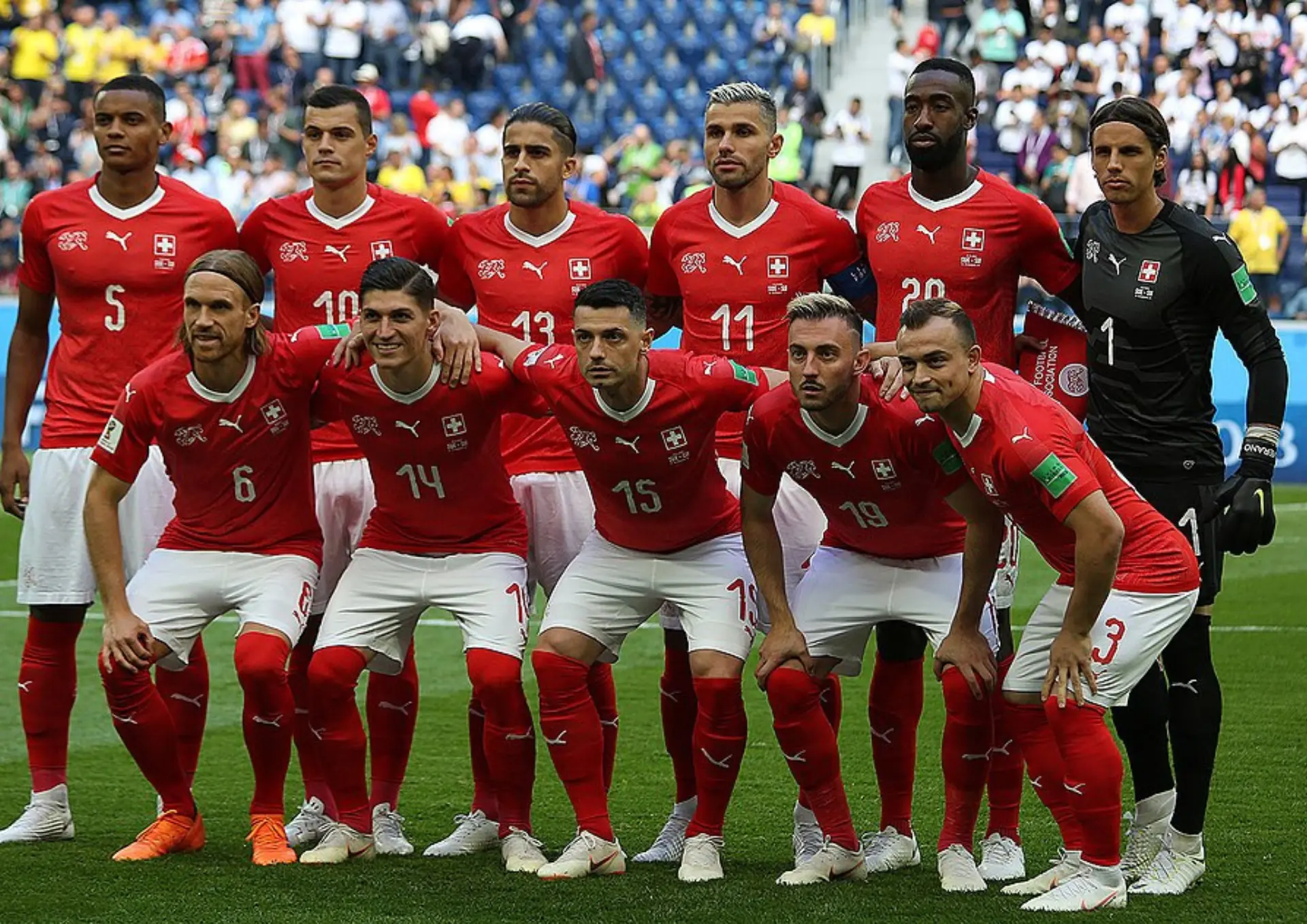
Switzerland have become a benchmark for consistency in international football, heading into their sixth straight World Cup in 2026. With experienced leadership from Granit Xhaka and tactical direction under Murat Yakin, they offer a blend of stability, structure, and tournament know-how that few teams outside the elite tier can match.
Switzerland secured qualification by topping UEFA Group B, going unbeaten with four wins and two draws, and confirming first place with a composed 1–1 draw away to Kosovo.
That ability to keep delivering results even after qualification is within reach reflects the squad’s discipline and mentality — a hallmark of teams that are built to perform consistently in tournament settings.
Tactical Discipline: Under Yakin, Switzerland operate in a fluid 3-4-2-1 system that is exceptionally hard to break down. Their defensive record in qualifying was excellent, and in recent knockout rounds, they have eliminated France, Italy, and Spain — three of the tournament’s favourites. This is not a team that simply parks the bus; they are capable of pressing high and transitioning with genuine quality.
Key figures in Switzerland’s 2026 squad underline their experience and balance, with ten players boasting 50+ international caps. Granit Xhaka leads the group with 144 appearances, providing leadership and control in midfield.
In goal, Gregor Kobel offers composure and reliability, while Manuel Akanji — a league-title winner with Manchester City and Inter Milan — anchors the defence alongside Nico Elvedi.
Up front, Breel Embolo leads the line, bringing a proven goal record with 23 goals in 85 international appearances, giving Switzerland a dependable focal point in attack.
Tournament Experience: Switzerland has reached the quarter-finals of the last two European Championships and regularly punches above its weight at major tournaments. They know how to manage group stages without blowing their energy.
What makes Switzerland stronger than the other Group B teams? It is the combination of elite club experience, tactical cohesion, and the mental resilience of a squad that has been competing at the highest level together for years. They arrive as firm favourites in our FIFA World Cup 2026 Group B predictions.
🇧🇦 Bosnia & Herzegovina – The Silent Threat for Qualification
If one narrative defines the unpredictability of FIFA World Cup 2026 Group B, it is the journey of Bosnia and Herzegovina.
They secured qualification dramatically, overcoming four-time champions Italy on penalties in the playoff final after already surviving a shootout against Wales in the semi-finals.
That path alone underlines a critical trait: this is a team that thrives under pressure rather than succumbing to it — a dangerous quality in tournament football where fine margins often decide everything.
Managed by Sergej Barbarez — a former international player who later pursued a career in professional poker — Bosnia and Herzegovina are emerging as a team with upward momentum. His presence brings authority and credibility within the dressing room.
While their dramatic qualification run might suggest a side fueled purely by emotion, a deeper examination reveals a squad with genuine quality and structure — suggesting their rise is built on more than just momentum.
The Džeko Factor: Edin Džeko remains the central figure for Bosnia and Herzegovina, even at 40. Currently playing for Schalke 04, he has continued to deliver, scoring six goals in 10 appearances since January — a testament to his enduring quality.
He is still the attacking reference point around which the team is built. When Džeko is in form, Bosnia possess a reliable focal striker capable of troubling any defence in the group. Without him, however, their attacking edge drops significantly, exposing a lack of comparable firepower.
Attack vs Defence Balance: Bosnia and Herzegovina are at their most dangerous when they commit numbers forward, particularly by creating overloads in wide areas to stretch opposition defences.
However, that attacking intent comes with a trade-off. Their defensive structure can be vulnerable, especially against quick-transitioning sides like Switzerland and Canada, both of whom are well-equipped to exploit space behind.
Emerging players such as Benjamin Tahirović — currently developing at Brøndby IF — bring energy and dynamism to midfield. That mix of youth and experience may ultimately prove to be Bosnia’s most valuable asset as they look to balance attacking ambition with defensive stability.
Why They Edge Canada for Second: Bosnia are more tactically organised than Canada and has the psychological edge of coming through extremely high-pressure situations to qualify. Canada’s squad has more individual quality, but Bosnia’s collective resilience makes them a marginally better bet for second place in our FIFA World Cup 2026 Group B predictions.
🇨🇦 Canada – The Strongest Third-Place Contender?
Canada’s position in the FIFA World Cup 2026 is one of the most compelling narratives in Group B. As co-hosts, they will play all three group-stage matches on home soil — across cities like Toronto and Vancouver — backed by intense, partisan support.
That advantage, however, comes with significant pressure. Canada has never progressed beyond the group stage in World Cup history, and this generation carries the weight of expectation to change that. The combination of home advantage and historical limitation creates a high-stakes environment where performance and psychology will be equally decisive.
The Golden Generation: Canada arrives with a core of high-level talent, including Tajon Buchanan (Villarreal CF), Jonathan David (Juventus FC), Stephen Eustáquio, and Jacob Shaffelburg (both at Los Angeles FC).
A key uncertainty, however, surrounds Alphonso Davies of FC Bayern Munich. His fitness could prove decisive. Davies is arguably Canada’s most influential player, and if he is limited or unavailable, the team loses its most explosive outlet on the flank — a critical component of their attacking threat.
Strengths: Home-crowd advantage in the group stage is real. Playing in front of sold-out stadiums in Toronto and Vancouver will elevate the performances of Canada’s younger players. Jonathan David is one of the most clinical strikers in European football right now and is capable of scoring against anyone.
What Could Go Wrong: Under Jesse Marsch, Canada clearly possesses the talent — but translating that into results at key moments has been inconsistent. There is a recurring pattern of underperforming relative to their individual quality in high-pressure matches, which remains a legitimate concern heading into the tournament.
A realistic scenario sees Canada finishing with one win, one draw, and one loss — a mixed return that, under the expanded FIFA World Cup 2026 format, could still be enough to progress as one of the eight best third-placed teams.
🇶🇦 Qatar – Can They Avoid a Bottom Finish?
No serious FIFA World Cup 2026 Group B prediction is complete without a clear-eyed assessment of Qatar — and while the outlook is challenging, it is not entirely without hope.
Qatar arrive having not played a competitive match since December 2025, a significant disadvantage for a side ranked 55th in the world and facing opponents like Canada, Switzerland, and Bosnia and Herzegovina. That lack of match sharpness could prove decisive in a group where tempo, cohesion, and in-game adaptability will be critical.
However, tournament football has a way of rewarding structure and discipline. If Qatar can remain compact, frustrate opponents, and capitalise on isolated moments, they retain at least an outside chance of influencing the group — even if progression remains a steep challenge.
Planned March friendlies against Serbia and Argentina — fixtures that would have provided valuable high-level preparation — were ultimately cancelled due to regional conflict. Instead, head coach Julen Lopetegui, who took charge in May 2025, opted to run a training camp as an alternative.
While that approach allowed for internal tactical work, it falls short of replicating the intensity and unpredictability of competitive international matches — a gap that could become evident during the tournament.
Lessons from 2022: Qatar became the first host nation in World Cup history to be eliminated in the group stage in 2022, failing to win a single match. The embarrassment was significant, and while the squad has evolved under Lopetegui, the fundamental quality gap between Qatar and their Group B rivals has not closed dramatically.
Individual Bright Spots: Despite the broader concerns, Qatar do possess pockets of quality. Captain Hassan Al-Haydos — who came out of international retirement for this campaign — brings experience and end product, with 41 goals in 184 appearances.
Up front, Almoez Ali offers a proven scoring record, having netted 55 goals in 118 internationals. Meanwhile, Akram Afif of Al Sadd SC remains their most creative and unpredictable attacking outlet.
However, the heavy reliance on players based in the domestic league presents a structural limitation. Against opposition from Europe and North America — such as Switzerland and Canada — that gap in competitive intensity and exposure could prove difficult to overcome.
Realistic Upset Chances: A point against Canada in Vancouver is not impossible if Julen Lopetegui sets Qatar up to frustrate and counter. The Qatar vs Bosnia game in Seattle looks like the clearest opportunity for a positive result. But expecting more than one point total would be overly optimistic in our FIFA World Cup 2026 Group B predictions.
Key Matches That Will Decide Group B
The Group B clash between Switzerland and Bosnia and Herzegovina on June 18 at SoFi Stadium shapes up as a defining encounter in the race for qualification.
This fixture could effectively determine second place in the group. Switzerland are likely to arrive with early momentum, potentially having secured points against Qatar, while Bosnia — coming off their opener against Canada — may already be under pressure to deliver a result.
Tactically, it sets up a compelling contrast: Sergej Barbarez’s counter-attacking approach against the structured pressing system of Murat Yakin. The margins are likely to be tight, but Switzerland’s control and discipline could give them a slight edge — a 2–1 result feels plausible in what promises to be one of the most intense and high-quality matches of the group stage.
The Group B opener between Canada and Bosnia and Herzegovina on June 12 at BMO Field could prove decisive for both teams’ qualification hopes.
This is arguably the most important match for each side in the group stage — the winner immediately gains control over their own path to the knockout rounds. The fact that Bosnia occupy this fixture instead of Italy adds an extra layer of intrigue, following Italy’s shock playoff elimination.
Canada’s home advantage is undeniable, with crowd support in Toronto likely to be intense. However, Bosnia’s recent experience in high-pressure playoff situations gives it a psychological edge in tight moments.
A draw appears the most probable outcome, which would keep the group finely balanced and place even greater importance on their remaining matches.
Canada vs. Qatar (June 18, BC Place, Vancouver). This is Canada’s must-win fixture. Failing to beat Qatar at home, in front of their own fans, would be a catastrophic result. Canada should win comfortably here, but the result is not as formality as many are assuming, given Canada’s historical inconsistency in big moments.
Final Group B Table Prediction
| Position | Team | W | D | L | GF | GA | Pts |
|---|---|---|---|---|---|---|---|
| 1st | Switzerland | 3 | 0 | 0 | 6 | 1 | 9 |
| 2nd | Bosnia & Herzegovina | 1 | 1 | 1 | 3 | 3 | 4 |
| 3rd | Canada | 1 | 1 | 1 | 3 | 4 | 4 |
| 4th | Qatar | 0 | 0 | 3 | 1 | 5 | 0 |
In our FIFA World Cup 2026 Group B predictions, Switzerland win the group comfortably with a perfect nine points. Bosnia and Canada finish level on four points, with Bosnia edging second place on goal difference — or potentially head-to-head record from their June 12 clash. Qatar finished bottom with no points, repeating the disappointment of 2022.
Why Switzerland tops with 9 points: Their quality is simply too great for this group. Beat Qatar with ease, edge Bosnia in LA, and they seal top spot against Canada in Vancouver even if they rest players.
Why Bosnia edges Canada: The head-to-head result on opening day is the key. Bosnia’s tournament experience under pressure gives them a marginal edge in the moments that matter.
Can Canada Still Qualify as a Best Third-Place Team?
Even in a scenario where Canada finishes third, the expanded structure of the FIFA World Cup 2026 provides a very real pathway to progression.
With 48 teams in play, the top two from each of the 12 groups advance automatically, joined by the eight best third-placed teams. That means only four of the twelve third-place finishers are eliminated — a significant safety net compared to previous formats.
In practical terms, a third-place finish with around four points — a total well within Canada’s reach — would likely be enough to secure qualification. That cushion keeps them firmly in contention even if their group-stage campaign is inconsistent.
Canada’s four-point projection (one win, one draw, one loss) would give them a strong goal-difference argument compared to third-place teams from tougher groups like Group C (Brazil) or Group I (France). This is a significant factor in our FIFA World Cup 2026 Group B predictions — Canada should not be written off even in the worst-case scenario.
Biggest Surprise & Potential Upset in Group B
The Bold Prediction: Bosnia & Herzegovina win the group.
It sounds outrageous, but consider the scenario: Bosnia beat Canada in Toronto with a Džeko goal in the 85th minute, then held Switzerland to a 1–1 draw in LA with a disciplined counter-attacking performance that Barbarez — the poker player turned manager — scripts to perfection. Suddenly, Bosnia are top with four points heading into a dead-rubber against Qatar.
Bosnia and Herzegovina once climbed to 13th in the FIFA rankings in 2013 — the high point of their golden generation — and the current squad shows signs of carrying a similar competitive edge.
Their route to the FIFA World Cup 2026 underlines that mentality, having already overcome Wales and Italy in penalty shootouts. That resilience under pressure suggests they have the psychological strength to challenge expectations and potentially spring a surprise in Group B.
The scenario analysis hinges entirely on Džeko. At 40, his legs may not last three games at World Cup intensity, but in short bursts, he remains capable of the match-winning moment. If Bosnia manage the group cleverly — prioritising their must-win games — they could absolutely be the group winner that shocks everyone in our FIFA World Cup 2026 Group B predictions.
Final Verdict – Who Advances & Who Goes Home
Our final FIFA World Cup 2026 Group B predictions come down to this:
Switzerland project as clear Group B winners, with little in the underlying data to suggest otherwise. Their squad is entering a mature phase, combining experience, tactical cohesion, and depth across all areas of the pitch.
Built on defensive organisation and structured pressing under Murat Yakin, Switzerland offer the most complete profile in the group — capable of controlling matches without overexposing themselves. That balance makes them not just favourites to top the group, but a side with the potential to progress deep into the FIFA World Cup 2026 rather than merely advancing past the opening stage.
Bosnia & Herzegovina advance in the second. The dramatic qualification story does not end in the group stage. Barbarez’s side is tactically astute enough to navigate the Switzerland loss and accumulate enough points from the Canada and Qatar games to squeeze through. Their opening game against Canada is the pivotal moment of the entire group.
Canada exits — but possibly as a third-place qualifier. The pressure of hosting, combined with an inconsistent recent record, ultimately costs them second place. However, the expanded format means their exit is not confirmed. A four-point haul likely keeps them alive as one of the eight best third-place teams.
Qatar go home without a point. A painful repeat of 2022 awaits. The lack of competitive preparation, the quality gap in every position, and a schedule that puts them against Switzerland first make a winless group stage almost inevitable.
Group B is not the most prestigious group in the 2026 tournament — no Argentina, no Brazil, no France. But it might just be the most compelling for neutral fans: a host nation fighting for its footballing soul, a romantic qualifier defying every expectation, the most consistent team in European football, and a Gulf state trying to prove 2022 was a fluke rather than a statement of intent. Whatever unfolds from June 12 onwards, the FIFA World Cup 2026 Group B predictions will be tested — and at least one of them will almost certainly be wrong.
Frequently Asked Questions (FAQs)
Who will win FIFA World Cup 2026 Group B?
Switzerland are the strong favourite to win Group B. Ranked 19th in the world, they arrive with six consecutive World Cup appearances, a flawless qualifying campaign, and a tactically mature squad led by Granit Xhaka. Unless Edin Džeko inspires a miraculous Bosnia upset, Switzerland winning the group with a perfect nine points is the most likely outcome.
Will Canada qualify from Group B at the 2026 World Cup?
Canada have a realistic but not guaranteed path to qualification. As co-hosts playing all three group games on home soil in Toronto and Vancouver, they have the crowd advantage and individual talent — through Jonathan David and a hopefully fit Alphonso Davies — to secure enough points. Even if they finish third behind Switzerland and Bosnia, the expanded 48-team format means the eight best third-place teams advance, giving Canada a solid safety net with four points.
How did Bosnia & Herzegovina qualify for the 2026 FIFA World Cup?
Bosnia & Herzegovina qualified in genuinely dramatic fashion through the UEFA playoffs. They first beat Wales on penalties in the semi-finals, then knocked out four-time world champions Italy on penalties in the playoff final on March 31, 2026. It was one of the most stunning results of the entire qualification cycle and instantly made them a team to watch in Group B.
Can Qatar win a match at the 2026 FIFA World Cup?
It is possible but unlikely. Qatar’s most realistic opportunity for a positive result comes against Bosnia & Herzegovina in their final group game in Seattle. Their best individual weapons — Akram Afif and Almoez Ali — are capable of moments of quality, but the squad’s reliance on Qatar-based league players, combined with a near-total lack of competitive matches since December 2025, makes winning any game in Group B a very tall order.
Is Group B the easiest group at the 2026 FIFA World Cup?
On paper, Group B is one of the more accessible groups in the tournament — there is no Argentina, Brazil, France, or Spain present. However, “easy” is relative. Switzerland are a genuine knockout-round threat capable of beating anyone on their day, Bosnia are unpredictable and battle-hardened, and Canada has the weight of a nation behind them on home soil. For any team aiming to go deep in 2026, navigating Group B still demands quality, consistency, and a clean sheet or two.
Also Read:-
FIFA World Cup 2026 Group C Predictions: Brazil Dominate, Morocco Surprise & Scotland Exit

I’m a football writer, covering top leagues like the Premier League, La Liga, Bundesliga, Serie A, and Ligue 1. I write about match analysis, football news, tactics, and major tournaments such as the FIFA World Cup, delivering clear, engaging insights for fans.
About The Author




1 thought on “FIFA World Cup 2026 Group B Predictions: Winners, Surprises & Shock Exits”