Paolo Maldini: The Best Serie A Player of All Time Revealed
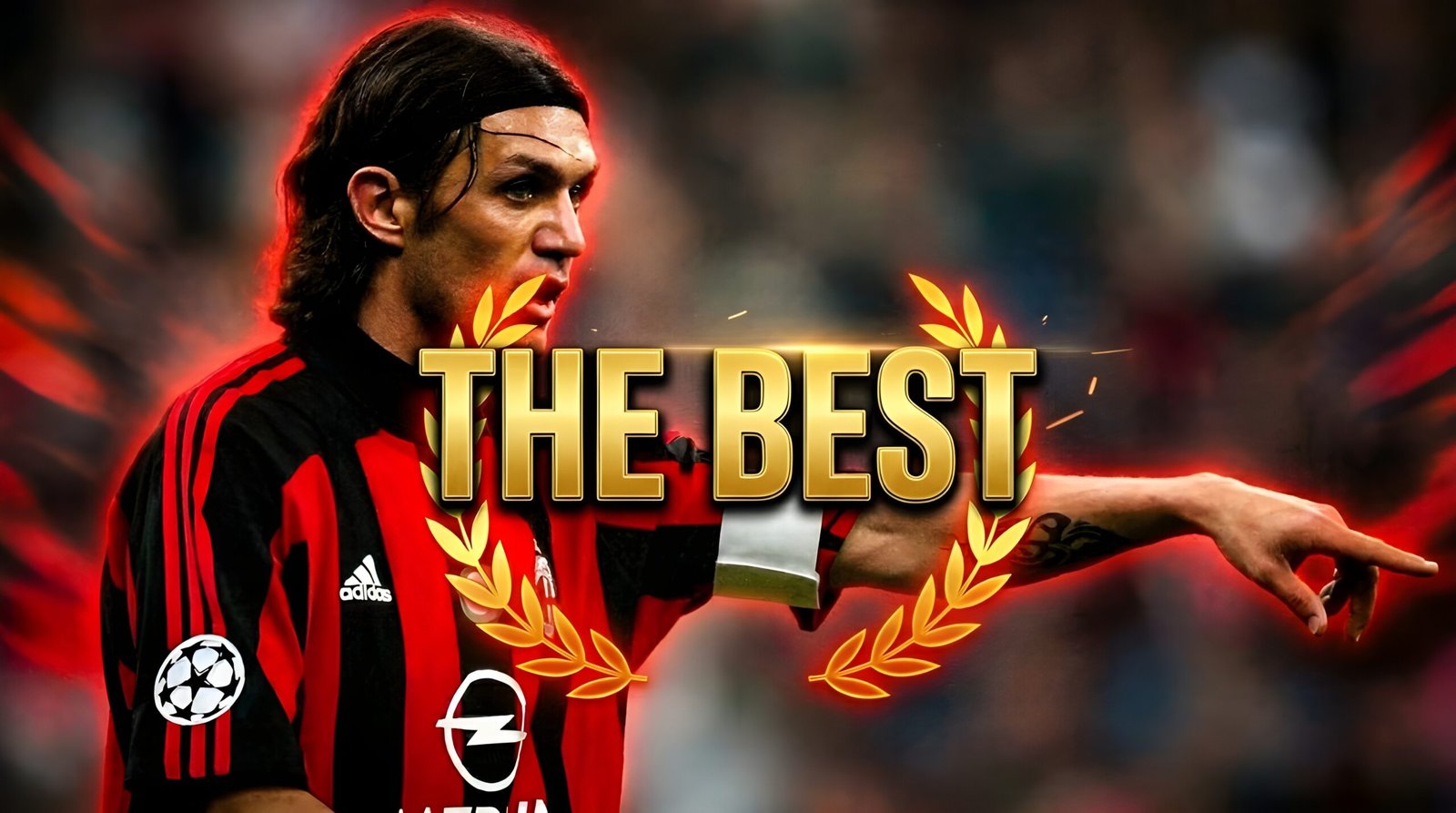
When football fans debate the best Serie A players of all time, one name surfaces above every other with near-universal agreement: Paolo Maldini. In a league that has hosted Maradona’s genius, Baggio’s artistry, Del Piero’s elegance, and Ronaldo’s power, a left-back — a defender — stands tallest of all. That alone tells you everything about the man’s extraordinary stature in Italian football.
Paolo Maldini spent 25 years at AC Milan, made 902 appearances for the club, won seven Serie A titles, and lifted the European Cup and UEFA Champions League five times. He played his first Serie A game at 16 and his last at 40, and across every single one of those seasons, he was among the finest players on the pitch. He wasn’t just one of the best Serie A players of all time — he was the standard against which all others are measured.
Why Is Paolo Maldini Rated Higher Than Maradona, Baggio, or Totti in Serie A History?
This is a question that ignites debates in every bar in Milan, Rome, and Naples. Maradona’s Serie A years at Napoli were transcendent. Baggio made grown men weep with his feet. Totti gave Roma his entire life. So why does Maldini still come out on top when ranking the best Serie A players of all time?
The answer lies in three words: longevity, consistency, and dominance.
| Player | Serie A Seasons | Titles | Top-Level Years | Position |
|---|---|---|---|---|
| Paolo Maldini | 25 | 7 | ~20 | Defender |
| Diego Maradona | 7 | 2 | 6 | Attacking Mid |
| Roberto Baggio | 16 | 1 | 10 | Forward |
| Francesco Totti | 22 | 1 | 14 | Forward |
| Alessandro Del Piero | 19 | 6 | 13 | Forward |
Maradona was a comet — blinding, brief, unforgettable. But Maldini was the sun: always there, consistently blazing, impossible to ignore. Baggio and Totti were attacking geniuses, but their trophy hauls pale against Maldini’s. And while attacking players naturally attract more individual glory, Maldini managed to win the Ballon d’Or runner-up spot in 1994 — as a defender — which speaks volumes about just how elite his performances were.
His defensive impact also shaped results far more reliably than even the most gifted attackers. Serie A’s catenaccio culture meant that a world-class defender could define a team’s fate as much as any forward. Maldini exploited that reality completely.
Who Are the Top 5 Serie A Players of All Time After Maldini?
When discussing the best Serie A players of all time beyond Maldini himself, five names rise above the rest:
1. Diego Maradona (Napoli, 1984–1991) — Took a mid-table club and made them Italian and European champions. His creative output and sheer magic remain unmatched in Serie A history.
2. Roberto Baggio (Fiorentina, Juventus, Milan, Bologna, Inter, Brescia) — The most technically gifted Italian of his generation. His dribbling, vision, and goal-scoring make him essential to any discussion of the best Serie A players of all time.
3. Francesco Totti (Roma, 1992–2017) — The spiritual captain of Rome, a one-club man who redefined the trequartista role. His loyalty and quality made him an icon.
4. Alessandro Del Piero (Juventus, 1993–2012) — Six Scudetti, Champions League glory, and a left foot that could thread needles from impossible angles. A monument of Italian football.
5. Andriy Shevchenko (AC Milan, 2001–2006) — The 2004 Ballon d’Or winner tore Serie A apart during Milan’s dominant era. His partnership with Maldini’s defensive wall produced one of the greatest club sides ever assembled.
How Would a Serie A All-Time XI Look With Maldini as Captain?
Picking a best-ever Serie A XI is one of football’s great thought experiments. Here’s how it looks with Maldini wearing the armband:
Formation: 4-3-3
| Position | Player | Club |
|---|---|---|
| GK | Gianluigi Buffon | Juventus |
| RB | Cafu | AC Milan |
| CB | Alessandro Costacurta | AC Milan |
| CB | Franco Baresi | AC Milan |
| LB | Paolo Maldini (C) | AC Milan |
| CM | Andrea Pirlo | AC Milan / Juventus |
| CM | Clarence Seedorf | AC Milan |
| CM | Zinedine Zidane | Juventus |
| RW | Alessandro Del Piero | Juventus |
| ST | Andriy Shevchenko | AC Milan |
| LW | Diego Maradona | Napoli |
The spine of this team — Buffon, Baresi, Maldini, Pirlo — forms arguably the most formidable defensive and transitional unit in football history. Maldini as captain is non-negotiable.
What Made Paolo Maldini Such a Complete Defender in Serie A?
To understand why Maldini leads every list of the best Serie A players of all time, you need to break down exactly what made him so different.
- Reading the game: Maldini rarely needed to tackle because he rarely allowed situations to develop to that point. His positioning was so precise that opponents found themselves closed down before they could threaten.
- Aerial ability: Despite being a full-back, Maldini was dominant in the air, combining athleticism with excellent timing.
- Tackling: When he did tackle, it was clean, decisive, and almost always successful. He averaged one of the lowest foul rates for a defender at his level throughout his career.
- Leadership: He captained Milan for 18 years. That kind of dressing room authority is earned, not assigned.
- Adaptability: Perhaps most impressively, Maldini began as a left-back and transitioned seamlessly into a centre-back as he aged, extending his top-level career by nearly a decade. Very few players in the history of the best Serie A players of all time have reinvented themselves so successfully.
Which Current Serie A Player Comes Closest to Maldini’s Legacy?
This is one of modern football’s most fascinating questions among those who track the best Serie A players of all time across generations. Two names consistently come up:
- Alessandro Bastoni (Inter Milan): The most stylish Italian defender of his generation. Excellent with the ball, composed under pressure, and already an Inter regular at a young age. He shares Maldini’s left-sidedness and his calm, controlled defending style.
- Marquinhos (PSG, but Brazilian international): Technically refined, a natural leader, and capable of playing multiple defensive roles. But he plays in Ligue 1, not Serie A, which limits the comparison.
Neither, however, approaches Maldini’s combination of longevity, trophy-winning consistency, and iconic one-club identity. Bastoni is the closest active player in spirit, but he would need another 15 years at Maldini’s level to enter the same conversation.
How Did Maldini’s Career With AC Milan Define Serie A’s Golden Era?
The late 1980s through the mid-2000s are widely considered Serie A’s global peak — a period when Italian football was the world’s best and most watched league. Maldini was at the centre of it all.
Under Arrigo Sacchi and later Fabio Capello, Milan played a brand of football that was tactically revolutionary: high press, zonal marking, ruthless collective organisation. Maldini was the embodiment of that system — disciplined enough for the structure, talented enough to transcend it.
His influence extended beyond results. He made Serie A’s defensive culture glamorous. Across Europe, young players grew up wanting to be Paolo Maldini, which is extraordinary given that most children dream of scoring goals, not preventing them. When historians discuss the best Serie A players of all time, they always note how Maldini elevated the perception of what a defender could be.
Could a Modern Defender Like Marquinhos or Rúben Dias Ever Surpass Maldini’s Reputation in Italy?
Bluntly: no. And not because they lack talent.
Modern football presents unique structural barriers to building the kind of legacy Maldini accumulated. Player movement between clubs is far more frequent, driven by financial incentives that didn’t exist in the same form during the 1990s. Maldini’s one-club commitment — 25 years, one badge, no temptation — is practically impossible to replicate in 2025.
Rúben Dias is an outstanding defender, and his influence at Manchester City has been transformative. But he plays in England, and his club loyalty has not yet been tested across multiple decades. Marquinhos has given years to PSG, but the club’s identity has been shaped more by its attacking stars than its defensive leaders.
Among the best Serie A players of all time, what makes Maldini uniquely irreplaceable is the symbiosis between player and club — a relationship so deep that Milan and Maldini became essentially one idea in football culture.
Who Is the Greatest Serie A Left-Back After Maldini?
Identifying Maldini’s nearest successor at left-back in Serie A history is genuinely difficult because the gap is substantial. The strongest candidates are:
- Gianluca Zambrotta: World Cup winner in 2006, capable of playing right-back or left-back, powerful and technically solid. He was perhaps the most complete Italian full-back of the post-Maldini generation.
- Massimo Ambrosini / Demetrio Albertini era peers: Several players filled adjacent roles but lacked Zambrotta’s versatility.
- Giovanni Di Lorenzo (Napoli): The modern challenger, consistent and dependable, but primarily a right-back by trade.
Among the best Serie A players of all time at left-back specifically, Zambrotta is the consensus second choice — but he is a distant second.
What Are Maldini’s Best Matches and Moments in Serie A?
Pinpointing the defining moments of a 25-year career is nearly impossible, but several performances stand apart:
- 1988–89 Serie A Season: Maldini was central to Milan’s unbeaten run and title charge, playing a key role in one of the most dominant domestic campaigns Italian football had ever seen.
- 1993–94 Serie A Title: At just 25, Maldini was already the spine of a Milan side that conceded only 15 goals across the entire league season — a defensive record that still astonishes.
- 2003–04 Champions League Campaign: At 35, an age when most defenders have retired, Maldini produced performances across Europe that reminded the world why he belongs at the very top of any list of the best Serie A players of all time.
- Derby della Madonnina performances: Maldini’s record in Milan derbies was extraordinary. Against Inter, in the highest-pressure fixture in Italian domestic football, he consistently delivered.
- Final season (2008–09): Playing centre-back at 40, still starting, still competitive. Arguably the most dignified farewell in football history.
How Would You Build a Best-Ever Serie A Team Around Maldini?
The previous all-time XI used a 4-3-3. But if the brief is to build specifically around Maldini and maximise how his qualities influence the team, a 4-4-2 with defensive solidity and rapid transition makes more sense:
Formation: 4-4-2 (Built Around Maldini)
| Position | Player |
|---|---|
| GK | Dino Zoff |
| RB | Cafu |
| CB | Franco Baresi |
| CB | Gaetano Scirea |
| LB | Paolo Maldini (C) |
| RM | Roberto Donadoni |
| CM | Andrea Pirlo |
| CM | Gennaro Gattuso |
| LM | Gheorghe Hagi |
| ST | Roberto Baggio |
| ST | Andriy Shevchenko |
This version leans into the catenaccio tradition that made Serie A the world’s greatest league — a steel defensive structure with Maldini as the cornerstone, and clinical finishing at the other end. Every discussion about the best Serie A players of all time eventually arrives at a team concept, and in every version, Maldini is the first name on the team sheet.
Conclusion: Why Paolo Maldini Remains the Benchmark in Italian Football
The debate around the best Serie A players of all time will never fully end. New generations will produce new heroes. Tactical evolutions will create new kinds of footballers. But the criteria by which greatness is measured — consistency, longevity, trophies, influence, loyalty — all point to the same man, every single time.
Paolo Maldini played 902 games for one club. He won seven league titles and five European Cups. He was still performing at the highest level at an age when most professionals have been retired for nearly a decade. He made defending look like an art form in a league that had turned defence into a philosophy.
When people talk about the best Serie A players of all time, they are really talking about two categories: Paolo Maldini and everyone else.
In Italian football, Maldini isn’t just the gold standard — he is the standard by which gold is measured.
Frequently Asked Questions (FAQs)
Is Paolo Maldini truly the greatest Serie A player of all time, or is it just opinion?
While football debates are always subjective, Maldini’s case is as close to an objective consensus as the sport allows. His combination of 25 seasons at the highest level, seven Serie A titles, 902 appearances for a single club, and sustained excellence across multiple decades gives him a statistical and cultural foundation that no other player in Serie A history can fully match. Experts, former players, and fans across Italy and the world consistently place him at the top, making it far more than just one opinion.
How many Serie A titles did Paolo Maldini win in his career?
Paolo Maldini won seven Serie A titles, all with AC Milan, across his career spanning from 1985 to 2009. Those title wins came in the 1987–88, 1991–92, 1992–93, 1993–94, 1995–96, 1998–99, and 2003–04 seasons. This trophy haul places him among the most decorated players in the history of the league and is a major reason he leads every credible list of the best Serie A players of all time.
Who is considered the best Serie A player of all time after Maldini?
Diego Maradona is most commonly cited as the second greatest Serie A player of all time. His seven seasons at Napoli, during which he single-handedly transformed a modest southern club into Italian and European champions, produced some of the most breathtaking individual football the league has ever witnessed. Roberto Baggio, Francesco Totti, and Alessandro Del Piero are also strong contenders depending on the criteria used — trophies, skill, longevity, or cultural impact.
Why is a defender like Maldini ranked above attacking legends in Serie A history?
Serie A has historically been a league that prizes defensive organisation above almost everything else. In that context, producing a defender so dominant that he finished second in the Ballon d’Or voting in 1994 — ahead of most of the world’s greatest attacking players that year — is a remarkable achievement. Maldini’s impact on results was as decisive as any forward’s, and his ability to shut down the world’s best attackers for over two decades gave him an influence that transcended the traditional bias toward goalscorers.
Could any current Serie A player ever reach Maldini’s level of legacy?
It is extremely unlikely. The modern football landscape — with frequent club transfers, shorter peak careers, and commercial pressures pulling players across leagues — makes it nearly impossible to replicate what Maldini built through 25 years of one-club loyalty. Alessandro Bastoni of Inter Milan is the current player most frequently compared to Maldini in terms of defensive style and Italian identity, but even he would need to sustain elite performance for another 15 or more years at Inter specifically to begin approaching that kind of legacy.

I’m a football writer, covering top leagues like the Premier League, La Liga, Bundesliga, Serie A, and Ligue 1. I write about match analysis, football news, tactics, and major tournaments such as the FIFA World Cup, delivering clear, engaging insights for fans.
About The Author