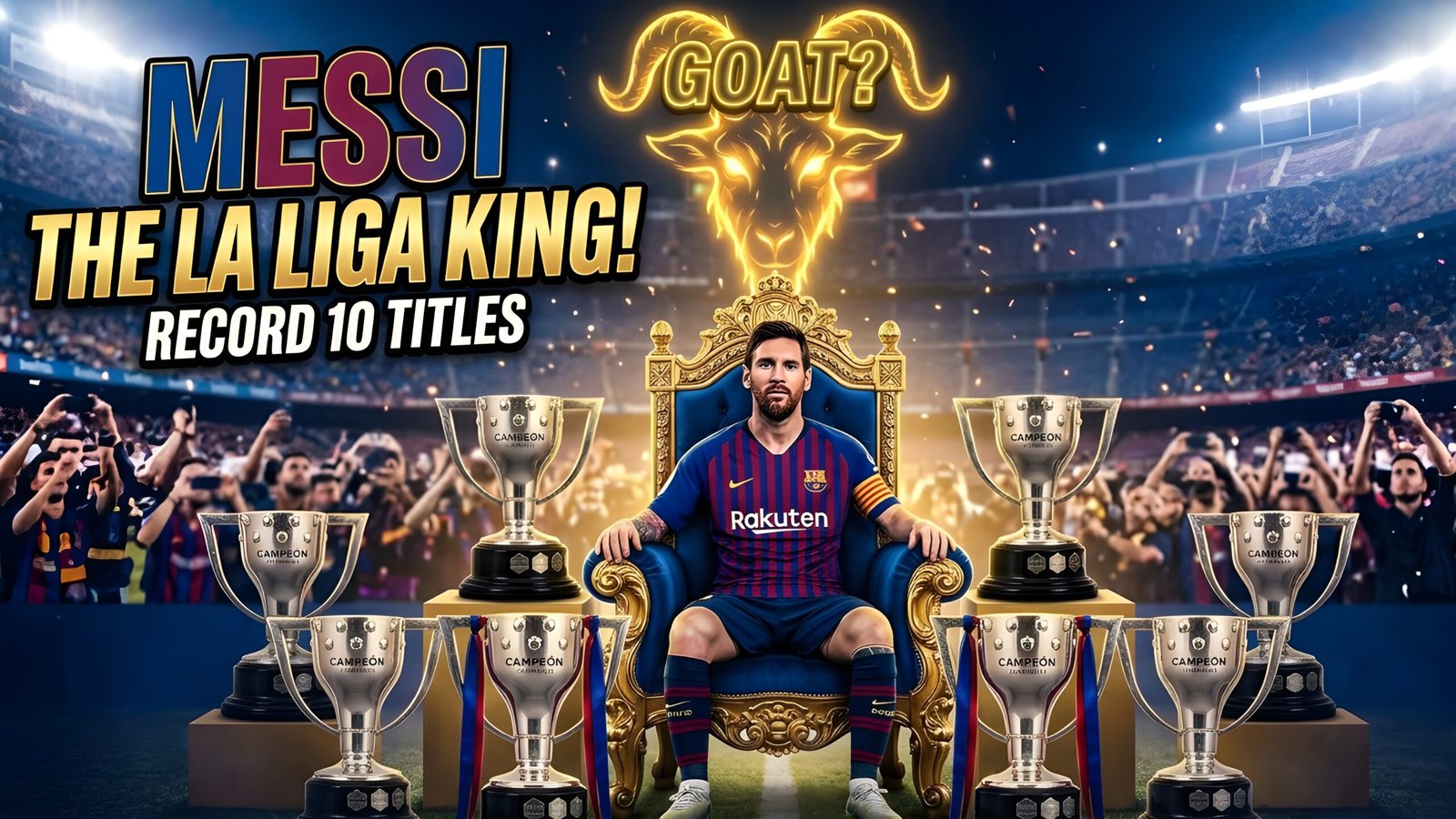
Lionel Messi: The Greatest La Liga Player of All Time. Why Is Messi La Liga’s Unrivaled King?
There is a debate that surfaces every few years in football circles, reignited by a new signing, a record-breaking season, or a generational talent arriving on Spanish shores. Yet no matter how the conversation begins, it almost always ends in the same place: Lionel Messi is the greatest La Liga player who has ever lived.
This is not a hot take. It is not fan bias dressed up as analysis. It is a conclusion backed by 17 years of relentless, jaw-dropping evidence — goals, assists, trophies, and moments of individual brilliance so frequent they stopped feeling miraculous and started feeling routine. That routinization of genius is, perhaps, the most remarkable thing about him. When you debate the greatest La Liga player across any era, any generation, any tactical system, Messi’s name is not just part of the conversation — it is the conversation.
He arrived at Barcelona as a teenager from Rosario, Argentina, with fragile bones and an enormous dream. He left as the greatest La Liga player in history, having rewritten every significant record the competition had to offer. Before we break down exactly why he stands alone, let’s start with the numbers that frame everything.
Core career La Liga statistics:
| Metric | Lionel Messi |
|---|---|
| La Liga Appearances | 520 |
| La Liga Goals | 474 |
| La Liga Assists | 193 |
| La Liga Titles | 10 |
| Pichichi Trophies | 8 |
| Seasons with 20+ Goals | 11 |
| Peak Season Goals (La Liga) | 50 (2011–12) |
Those figures do not belong to a player. They belong to a phenomenon.
Who Holds Every Major La Liga Record?
When you sit down and list La Liga’s records, something extraordinary happens: one name appears next to almost all of them. The greatest La Liga player is not merely a holder of one or two impressive marks — he owns the entire record book.
474 goals. That is Messi’s all-time La Liga goals tally, a number so far ahead of every other player in history that it borders on the absurd. For context, Telmo Zarra, the man whose record Messi eventually broke in 2014, scored 251 goals across his entire career — Messi had already lapped him. Even Cristiano Ronaldo, the only footballer of his generation capable of being mentioned in the same breath, finished his La Liga career with 311 goals, over 160 behind.
Then there are the 193 assists — the all-time La Liga record for a single player. While it is fashionable to celebrate Messi purely as a goalscorer, this figure tells you something deeper. The greatest La Liga player was also, simultaneously, the greatest creative force the league has ever seen. He was the last line of attack and the first line of creation, often in the same 90 minutes.
His eight Pichichi trophies — awarded to La Liga’s top scorer each season — are another record that stands entirely alone. No player in the history of Spanish football has come close. That consistency across a decade-plus of competition, against evolving defenses specifically designed to stop him, is what separates the greatest La Liga player from every other contender.
| Record | Messi’s Mark | Previous/Closest Holder |
|---|---|---|
| All-Time La Liga Goals | 474 | Cristiano Ronaldo (311) |
| All-Time La Liga Assists | 193 | Xavi Hernández (~150) |
| Pichichi Trophies | 8 | Zarra / Hugo Sánchez (5 each) |
| Goals in a Single La Liga Season | 50 | Hugo Sánchez (38) |
| La Liga Titles | 10 | Multiple players |
Can Ronaldo’s Stats Even Touch Messi’s Longevity?
Cristiano Ronaldo spent four seasons at Real Madrid — from 2009 to 2018 — and his La Liga numbers are genuinely extraordinary. 311 goals in 292 appearances. That’s an average of over a goal per game, and in any other era, against any other player, it would make him the easy answer to “greatest La Liga player.”
But Messi’s longevity changes the calculus entirely. While Ronaldo delivered brilliance in concentrated bursts, Messi sustained his at Barcelona for 17 full seasons. He won 10 La Liga titles. He scored 20 or more league goals in 11 consecutive seasons. He played through tactical revolutions, coaching changes, the loss of Xavi, the loss of Iniesta, financial crises at the club, and still kept producing at a level that would be considered a career peak for anyone else.
| Metric | Messi (La Liga) | Ronaldo (La Liga) |
|---|---|---|
| Appearances | 520 | 292 |
| Goals | 474 | 311 |
| Assists | 193 | ~97 |
| Goals Per Game | 0.91 | 1.06 |
| Titles | 10 | 2 |
| Seasons Played | 17 | 9 |
Ronaldo’s goals-per-game ratio is marginally higher — 1.06 to Messi’s 0.91. It’s the one statistical concession you can honestly make. But when you factor in that Messi also leads in total goals despite playing 228 more games, that Messi holds double the titles, and that Messi’s assist record isn’t remotely challenged, the verdict for the greatest La Liga player does not waver.
What Makes Messi’s Dribbling Simply Unstoppable?
Statistics are one thing. But any honest argument about the greatest La Liga player must also reckon with what he looked like to watch — because Messi’s dribbling was something that did not fit into a spreadsheet.
The Getafe goal from April 2007 is the reference point everyone reaches for, and rightly so. Collecting the ball inside his own half, Messi beat five outfield players and the goalkeeper before finishing from inside the six-yard box. It was immediately — and accurately — compared to Diego Maradona’s famous goal against England in 1986. But where Maradona did it once on the grandest stage, Messi produced moments of comparable individual brilliance with terrifying regularity across two decades.
His dribble success rate in La Liga consistently ranked among the highest in European football. His low center of gravity — a product of the growth hormone treatment he underwent as a child — gave him a physical base that made him almost impossible to knock off the ball. Defenders who tried to foul him often found themselves stumbling over nothing; he was simply no longer where they expected.
What makes the case for him as the greatest La Liga player even stronger in this regard is volume. Maradona was a transcendent dribbler. So was Ronaldinho. But neither sustained that level across the number of seasons, appearances, and competitive minutes that Messi did.
How Did Messi Win 8 Pichichi Trophies?
The Pichichi Trophy — La Liga’s golden boot, awarded to the top scorer each season — is one of Spanish football’s most prestigious individual honors. Winning it three times would make you a legend. Winning it five times, as both Telmo Zarra and Hugo Sánchez did, would cement your place among the all-time greats.
Messi won it eight times.
The secret, if it can be called that, was an almost supernatural consistency. He scored 20 or more La Liga goals in 11 consecutive seasons. That span covers the complete arc of a typical player’s career — the entire time most professionals have at their peak, Messi spent simply never dipping below a 20-goal season.
| Season | La Liga Goals | Pichichi? |
|---|---|---|
| 2009–10 | 34 | ✅ |
| 2010–11 | 31 | ✅ |
| 2011–12 | 50 | ✅ |
| 2012–13 | 46 | ✅ |
| 2016–17 | 37 | ✅ |
| 2017–18 | 34 | ✅ |
| 2018–19 | 36 | ✅ |
| 2019–20 | 25 | ✅ |
Even in the seasons where he did not win the Pichichi, he was rarely far from the top. For any honest discussion of the greatest La Liga player, this table alone should close the debate.
Is Messi’s Playmaking Better Than Any Forward’s?
One of the quiet arguments that gets lost when people debate the greatest La Liga player is just how good Messi was as a creator. His 193 La Liga assists are the all-time record, but the number undersells the reality, because many of his most important contributions never registered as official assists at all.
He would draw two or three defenders out of position and lay the ball to Xavi, who then played it to Iniesta for the goal. Technically, one assist. In reality, the architect of the entire move. His vision was so far ahead of those around him that he was often making decisions that only became comprehensible to the watching world a second after they happened.
Xavi Hernández, one of the finest midfielders in football history, has said on multiple occasions that playing with Messi made him a better player. Iniesta echoed the sentiment. Neymar, during his time at Barcelona, visibly elevated his own game in connection with Messi. This is what the greatest La Liga player did to everyone around him — he didn’t just contribute, he multiplied.
No forward in the history of La Liga has combined goal-scoring and creation at this level. Not Ronaldo, not Di Stéfano, not Raúl. The 193 assists are the headline, but the full truth of Messi’s playmaking is even larger than that number.
Why Do Experts Rank Messi #1 Over Di Stéfano?
Alfredo Di Stéfano is the historical comparison that serious football historians deploy when they want to challenge Messi’s position as the greatest La Liga player. Di Stéfano’s Real Madrid won five consecutive European Cups between 1956 and 1960. He scored in all five finals. He was the engine of the most dominant club side Europe had seen to that point, and his complete footballer profile — pressing, defending, creating, scoring — was decades ahead of its time.
The respect for Di Stéfano is entirely warranted. He is legitimately one of the three or four greatest footballers who ever lived.
But modern rankings from outlets like GiveMeSport, Football Whispers, and ESPN consistently place Messi above Di Stéfano as the greatest La Liga player, and the reasoning is sound. Messi operated in the most tactically sophisticated, athletically demanding era of the sport’s history, against defenses built specifically to neutralize him, with GPS tracking and video analysis leaving no weakness unexploited — and he still produced numbers that are historically unprecedented.
Di Stéfano played in an era before squad rotation, before sports science, and before the globalization of football talent at every club. This is not to diminish him — it is simply to acknowledge that comparison across eras is imprecise, and that on the metrics we can measure, Messi’s case is overwhelming.
Can Mbappé or Bellingham Break Messi’s Records?
As of 2026, Kylian Mbappé is in his second season at Real Madrid, and Jude Bellingham has established himself as one of the most dynamic midfielders in the world. Both are legitimate generational talents. Neither, at this stage, is remotely close to threatening Messi’s all-time La Liga records — and the arithmetic makes it very clear why.
Messi’s 474 La Liga goals came over 520 appearances and 17 seasons. Even at Ronaldo’s exceptional rate of 1.06 goals per game, a player would need roughly 447 appearances — approximately 13 full seasons at 35 games per season — just to threaten the record. Mbappé is a natural goalscorer, but he arrived in Spain later in his career than Messi did. Bellingham, as a midfielder, is not built to challenge a scoring record of this scale.
| Player | Current La Liga Goals | Seasons Needed to Reach 474 (at current rate) |
|---|---|---|
| Kylian Mbappé | ~30+ | 10+ additional seasons |
| Jude Bellingham | ~20+ | 15+ additional seasons |
| Vinícius Jr. | ~80+ | 8–10 additional seasons |
The 0.91 goals-per-game benchmark that defines Messi’s overall La Liga career remains, as of 2026, the standard that every new star in the league is measured against. The greatest La Liga player set a bar that the current generation is still running toward.
What Single Season Proves Messi’s Greatness?
If you had to choose one season that encapsulates everything about why Messi is the greatest La Liga player in history, the answer is 2011–12. It is not a close call.
In that single La Liga campaign, Messi scored 50 goals — a record that shattered Hugo Sánchez’s previous La Liga high of 38, set in 1990. Fifty goals in a 38-game league season. That is a rate of 1.32 goals per game, sustained over an entire competitive season, against the world’s best defensive teams.
He also contributed 24 assists that season, making him directly involved in 74 La Liga goals. Barcelona finished the season with 100 points — a record at the time —, and Messi was the engine of almost everything.
For perspective: the highest number of goals scored by any other La Liga player in a single season that year was 24. Messi scored more than double his nearest rival. If you were asked to design a season that proved a player was the greatest La Liga player of all time, it would look exactly like Messi’s 2011–12.
How Messi’s 91 Goals in 2012 Shocked the World
The 50-goal La Liga season did not exist in isolation. It was part of an even more staggering achievement: in the calendar year of 2012, Lionel Messi scored 91 goals across all competitions for club and country, breaking Gerd Müller’s record of 85 set in 1972.
Of those 91, the La Liga contribution was at the core — 50 league goals, supplemented by Champions League, Copa del Rey, and international goals that together painted a picture of a player operating at a level simply not seen before in the sport’s modern era.
Müller’s record had stood for 40 years. It had survived Pelé, Cruyff, Maradona, Ronaldo, and Van Nistelrooy. Messi did not just break it — he broke it by six goals, with a month still remaining in the year. The greatest La Liga player did not approach records gently. He demolished them.
The Verdict
Every metric, every era, every comparison point in the same direction. The greatest La Liga player of all time is Lionel Messi — not by a narrow margin, not on a technicality, but by the kind of overwhelming, multi-dimensional evidence that makes the debate feel somewhat one-sided once you lay it all out.
474 goals. 193 assists. 10 titles. 8 Pichichi trophies. The Getafe goal. The 50-goal season. The 91-goal year. Seventeen years of weekly, relentless, transcendent football played at the highest level of club competition on the planet.
Other players have been brilliant. Di Stéfano was a visionary. Ronaldo was a machine. Raúl was a leader. Hugo Sánchez was a clinical artist. But none of them — across any era, any system, any context — did what Messi did, for as long as Messi did it, at the level Messi sustained.
The greatest La Liga player has already played. His name is tattooed into every record book the competition has, and it will take a talent so extraordinary it may never arrive to erase it. For now, and perhaps forever, the throne belongs to the little man from Rosario.

I’m a football writer, covering top leagues like the Premier League, La Liga, Bundesliga, Serie A, and Ligue 1. I write about match analysis, football news, tactics, and major tournaments such as the FIFA World Cup, delivering clear, engaging insights for fans.
About The Author
1 thought on “The Greatest La Liga Player of All Time – One Name Stands Above the Rest”