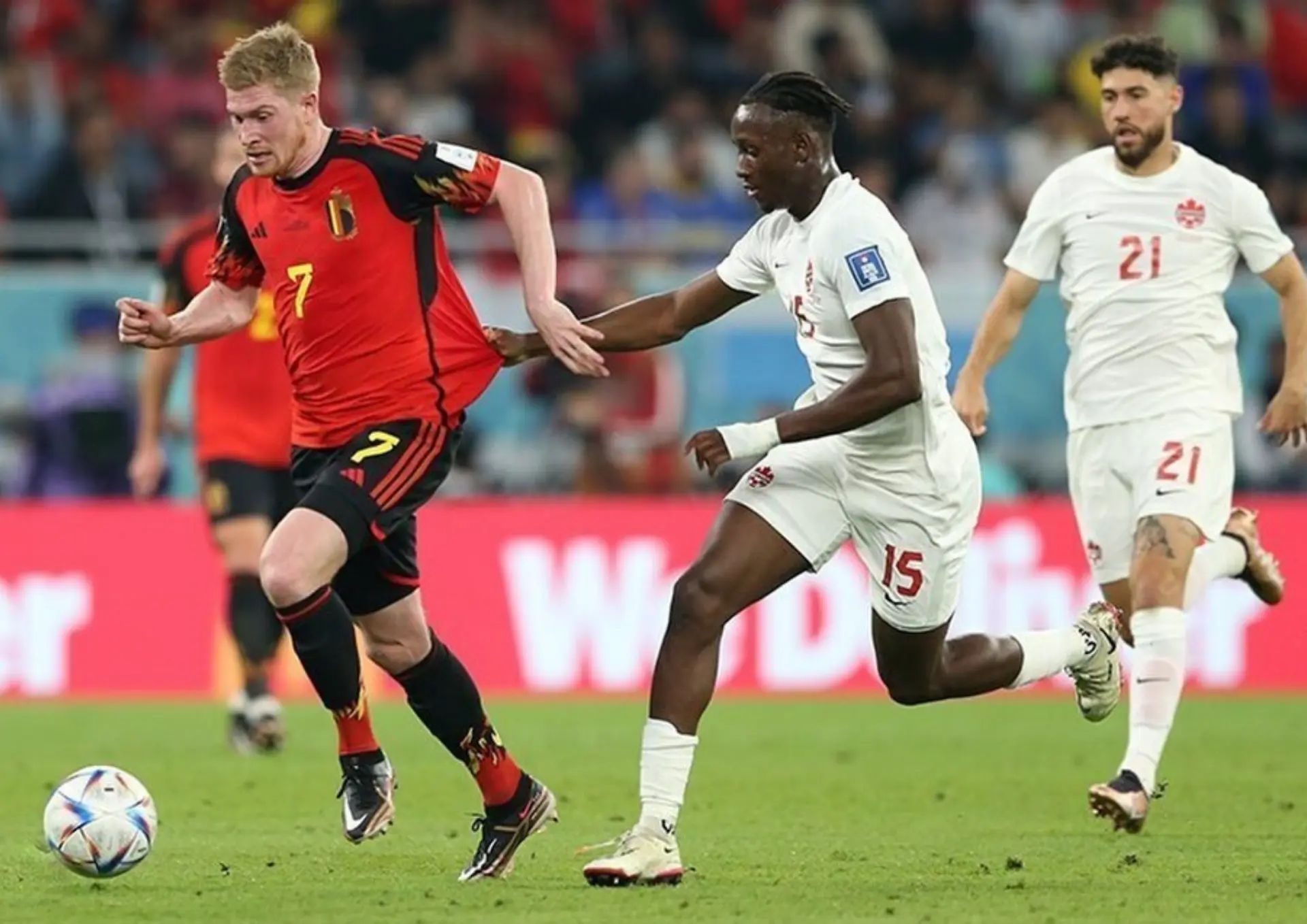
FIFA World Cup 2026 Group G Predictions: Belgium Lead, Egypt Rise & Tough Exits
When the FIFA World Cup 2026 draw was completed, Group G immediately stood out as one of the more intriguing pools of the tournament. On paper, it might look like a straightforward Belgium walkover, but dig deeper and the FIFA World Cup 2026 Group G predictions tell a much richer story — one of fading golden generations, African ambition, Asian resilience, and an Oceanian underdog trying to prove the world wrong.
Group G Overview – European Experience vs African Ambition
Group G of the FIFA 2026 World Cup features Belgium, Egypt, Iran, and New Zealand, creating a highly contrasting mix of styles and experience levels. Belgium brings European structure and tournament pedigree, Egypt offers an attacking threat led by Premier League-quality forwards, Iran provides disciplined defensive organisation and resilience, while New Zealand arrives as underdogs relying on physicality and collective effort. The result is a tactically diverse group where the battle for qualification beyond Belgium is expected to be tightly contested.
The Group G fixture list at the FIFA World Cup 2026 builds steadily toward a decisive final day, starting with Belgium vs Egypt and Iran vs New Zealand on June 15. Matchday two sees Belgium face Iran and Egypt take on New Zealand, before everything culminates on June 26 with simultaneous kick-offs: Egypt vs Iran and New Zealand vs Belgium, setting up a likely final-round decider for qualification spots.
🇧🇪 Belgium – Golden Generation Still Strong Enough?
Few national teams have carried as much unfulfilled promise into as many tournaments as Belgium. Belgium has been one of Europe’s most consistent national teams over the past decade, qualifying for every major tournament since 2014 and finishing third at the 2018 World Cup — the best result in the country’s history. The team’s recent cycle included deep runs at Euro 2016 and Euro 2020 and sustained periods ranked No. 1 in the FIFA world rankings.
Belgium enters the FIFA World Cup 2026 with a transitional but still highly competitive “golden generation” under Rudi Garcia, blending elite experience with emerging talent. The squad is anchored by Thibaut Courtois in goal, a deep midfield core featuring Kevin De Bruyne, Youri Tielemans, and Amadou Onana, and a versatile attack led by Romelu Lukaku alongside Jeremy Doku and Leandro Trossard. Despite generational turnover, the balance of experience, technical quality, and depth keeps Belgium among the strongest sides in Group G.
Belgium’s attack in the FIFA World Cup 2026 is still heavily shaped by the leadership of Kevin De Bruyne, whose vision, passing range, and game control make him the primary creative hub and on-field leader. Up front, Romelu Lukaku remains their most reliable goal source and all-time top scorer, bringing proven finishing quality and physical presence, especially in decisive tournament moments as Belgium transitions into a new phase of their squad cycle.
Belgium’s attacking structure at the FIFA World Cup 2026 is built around pace and directness from Jérémy Doku and Leandro Trossard, who operate behind Romelu Lukaku to stretch defenses and create high-quality chances. At the other end, Thibaut Courtois provides elite goalkeeping security, giving Belgium a strong defensive foundation to complement their attacking talent.
Belgium is widely tipped to win Group G of the FIFA World Cup 2026, with its attacking depth considered unmatched in the group. Led by creative force Kevin De Bruyne, explosive winger Jérémy Doku, clinical finisher Romelu Lukaku, and additional firepower from Loïs Openda, they have more than enough quality to consistently overwhelm opponents and control the group from start to finish.
🇪🇬 Egypt – Can They Lead Africa’s Charge?
Egypt arrives at this World Cup with something to prove. The Pharaohs were unbeaten in their qualifying group, winning eight out of 10 games to ensure they comfortably finished top. With Salah and Manchester City’s Omar Marmoush leading from the front, Egypt proved a potent attacking force in qualifying, scoring 20 times and conceding just twice in 10 matches.
Mohamed Salah needs no introduction as he enters the FIFA World Cup 2026 at the peak of a record-breaking international career, having become his nation’s all-time leading scorer and the top scorer in CAF World Cup qualifying. With 67 international goals and counting, his legacy-defining mission is to translate that form onto the world stage and deliver a deep tournament run for Egypt.
Egypt enters the FIFA World Cup 2026 with a dangerous attacking core led by Mohamed Salah and Omar Marmoush, whose combined experience in top European leagues makes them a high-impact duo. Marmoush adds Bundesliga and Europa League pedigree from spells with Wolfsburg, Stuttgart, and Eintracht Frankfurt, complementing Salah’s elite finishing and creativity, and together they form one of the most potent attacking partnerships in the tournament.
Defensively, Egypt is no longer a soft touch. Egypt’s defensive record across CAF qualifying was outstanding, with seven clean sheets and only two goals conceded in 10 matches. The structure under coach Hossam Hassan is compact and disciplined, with the midfield sitting narrow and the center-backs providing experienced leadership to protect central areas aggressively.
Mohamed Salah enters the FIFA World Cup 2026 at a pivotal stage of his international career, having already become Egypt’s all-time leading scorer and the top scorer in CAF World Cup qualifying. Now in the latter phase of his career, the urgency to finally secure Egypt’s first-ever World Cup victory adds even greater weight to his legacy.
Egypt is a strong candidate for second place in Group G of the FIFA World Cup 2026, with their attacking threat led by Mohamed Salah giving them the ability to trouble even top sides like Belgium. Their organized defensive structure also makes them well-equipped to handle physically disciplined teams such as Iran and New Zealand, strengthening their case as the most likely team to finish behind Belgium in the group.
🇮🇷 Iran – Solid but Not Enough to Progress
Iran is far from a pushover, and any FIFA World Cup 2026 Group G predictions that dismiss them do so at their peril. Iran arrives as one of Asia’s most experienced qualifiers, making their fourth consecutive appearance under coach Amir Ghalenoei. Their qualifying campaign was genuinely impressive — Iran lost only one of 16 AFC matches, finished eight points clear of third-placed UAE in their group, and averaged close to two goals per game while conceding under one per match.
Iran enters the FIFA World Cup 2026 with a clearly defined identity built on defensive structure, discipline, and transition play, anchored by goalkeeper Alireza Beiranvand and striker Mehdi Taremi as their main reference points in both phases of the game.
However, while their compact organization makes them difficult to break down, the key concern is efficiency in the final third. Against higher-quality opponents, Iran can struggle to convert limited chances, which may ultimately decide tight group-stage matches.
Their best hope for progression runs through a first-game victory against New Zealand. Without those three points, Iran’s road becomes extremely narrow. Compact defending can frustrate Belgium and Egypt for spells, but goals from set pieces or individual moments of quality are what they’ll ultimately need — and that’s a fragile foundation to build a qualification campaign upon.
Iran is the group’s great “nearly” team. Disciplined enough to compete, but not clinical enough to advance. That, in a nutshell, is why most FIFA World Cup 2026 Group G predictions place them third.
🇳🇿 New Zealand – Underdogs Facing a Huge Gap
New Zealand’s return to the World Cup after a 16-year absence is a feel-good story, but sentiment won’t win them points against Belgium, Egypt, and Iran. Under coach Darren Bazeley, the All Whites won all five of their OFC qualifying matches, beat Fiji 7-0 in the semi-final and New Caledonia 3-0 in the final, conceding just one goal across the entire campaign. The team has found consistency built around physicality, organization, and the individual quality of Chris Wood.
New Zealand relies on a direct, physical approach at the FIFA World Cup 2026, with Chris Wood leading the line, a midfield focused on winning second balls, and a compact defensive shape. While this structure is effective in Oceanian competition, the step up in technical quality and tempo in Group G will test whether that approach can hold against stronger, more dynamic opponents.
The tactical plan is clear: stay organized, frustrate opponents, and hope Chris Wood can nick a goal. New Zealand’s key match — the one where a shock is genuinely possible — is against Iran on June 15. A draw or better would give them something to fight for. Anything less and they’ll be playing the final game against Belgium simply for pride.
Key Matches That Will Decide Group G
Belgium vs. Egypt (June 15 — Seattle): Belgium vs Egypt is the standout fixture of Group G at the FIFA World Cup 2026, likely determining the group winner from the opening day. With Mohamed Salah and Kevin De Bruyne sharing the pitch, it becomes the defining individual duel of the group stage. A Belgium victory would reinforce expectations, while an Egypt win would immediately disrupt the projected hierarchy and reshape the entire Group G narrative.
Egypt vs. Iran (June 26 — Seattle): This is the qualification decider. Whichever team comes into this final matchday needing points will face enormous pressure. Egypt’s attacking weapons should carry them through, but Iran’s organized defense could make this uncomfortable until late in the game.
Iran vs. New Zealand (June 15 — Inglewood): Iran vs New Zealand is effectively the survival clash of Group G at the FIFA World Cup 2026, with the winner gaining a realistic pathway toward qualification or a best third-place finish. Iran enters knowing these three points are essential to remain competitive, while New Zealand sees this as their clearest chance to secure a historic result before facing stronger opposition, making it a high-intensity, high-stakes encounter from the opening whistle.
Final Group G Table Prediction
| Position | Team | W | D | L | GF | GA | GD | Pts |
|---|---|---|---|---|---|---|---|---|
| 1st | 🇧🇪 Belgium | 3 | 0 | 0 | 7 | 2 | +5 | 9 |
| 2nd | 🇪🇬 Egypt | 2 | 0 | 1 | 5 | 3 | +2 | 6 |
| 3rd | 🇮🇷 Iran | 1 | 0 | 2 | 2 | 5 | -3 | 3 |
| 4th | 🇳🇿 New Zealand | 0 | 0 | 3 | 1 | 5 | -4 | 0 |
Belgium’s class and squad depth make a clean sweep of the group stage very achievable. Egypt, energized by their first World Cup in eight years and led by Salah’s desperation to finally win a match on this stage, should collect six points comfortably. Iran’s opening win over New Zealand earns them a solitary victory, while the All Whites exit without a point but with the experience of competing again at the tournament’s highest level.
These FIFA World Cup 2026 Group G predictions are rooted in squad quality, tactical trends, and recent form — but football, of course, has other ideas.
Can Egypt Challenge Belgium for First Place?
This is the most tantalizing subplot within all FIFA World Cup 2026 Group G predictions. The case for Egypt finishing first rests almost entirely on what happens on June 15 in Seattle when the two sides meet.
Tactically, Egypt’s 4-2-3-1 structure will look to neutralize Belgium’s midfield creativity while unleashing Salah and Marmoush on the counter. Belgium’s transitional defense has been flagged as a vulnerability, and those are precisely the kind of spaces Egypt’s forwards feed on.
The problem? Belgium’s own individual quality is enormous. The squad’s strengths include an elite midfield led by Kevin De Bruyne’s vision and Amadou Onana’s box-to-box energy, wide threats from Jérémy Doku and Loïs Openda providing pace and goals, and tournament pedigree across their last three knockout stage appearances.
Egypt upsetting Belgium in the FIFA World Cup 2026 is not the most likely outcome, but it sits firmly within a realistic 25–30% probability range. If Mohamed Salah is fully fit and operating at his peak influence, Egypt possesses enough attacking quality to disrupt Belgium’s structure. Any projection that completely rules out Egypt topping the group overlooks a credible pathway — one where a single high-impact performance reshapes the entire Group G hierarchy.
Biggest Surprise & Potential Shock in Group G
Iran upset scenario: If Iran beat New Zealand and then frustrate Egypt in a goalless draw, they would need just a point against Belgium to potentially squeeze through as a third-placed team. It’s a narrow route, but third-placed teams do advance in the new 48-team format. Given that the top two teams and eight third-placed teams progress, there is a realistic — if slim — path for Iran.
Egypt’s potential top finish: Egypt has a legitimate pathway to topping Group G in the FIFA World Cup 2026, driven by the individual brilliance of Mohamed Salah and a disciplined, well-drilled defensive structure. If they secure a result against Belgium in the opener and manage the remaining fixtures with tactical control, a first-place finish is entirely achievable—an outcome that would mark a historic milestone for Egyptian football.
Final Verdict – Who Advances & Who Gets Eliminated
Belgium (1st) — Advance. Too strong, too deep, and too experienced. The Red Devils’ golden generation has one last shot at glory, and wasting the group stage is not part of the plan.
Egypt (2nd) — Advance. Egypt is strongly positioned to qualify from Group G of the FIFA World Cup 2026, with Mohamed Salah leading what could be his final World Cup campaign. A second-place finish would likely set up a Round of 32 clash against sides like the United States, Paraguay, or Australia—all matchups that are competitive and winnable on paper. This Egyptian team has the structure, experience, and attacking quality to do more than just participate; they are a genuine threat to progress deeper into the tournament.
Iran (3rd) — Eliminated. Admirable and disciplined, but ultimately unable to generate the quality needed to progress from this group. Their best chance of survival as a third-placed team depends on results elsewhere and is more hopeful than probable.
New Zealand (4th) — Eliminated. New Zealand arrives at the FIFA World Cup 2026 after dominating the Oceania Football Confederation, but the step up in opposition quality is significant. While their consistency in OFC qualifying highlights structure and discipline, the technical, tactical, and individual quality of Belgium, Egypt, and Iran represents a completely different level—one that will test whether New Zealand can remain competitive over three high-intensity group-stage matches.
Frequently Asked Questions (FAQs)
Who will win FIFA World Cup 2026 Group G?
Belgium is the heavy favorite to win Group G. Their squad depth, tournament experience, and the creative quality of Kevin De Bruyne and Jeremy Doku make them the standout side. Unless Egypt pulls off a surprise in the opening fixture, the Red Devils should top the group with nine points.
Will Egypt qualify from Group G at the 2026 World Cup?
Yes, in most FIFA World Cup 2026 Group G predictions, Egypt qualifies as the runner-up. The Salah-Marmoush attacking combination, combined with their outstanding defensive record in qualifying (seven clean sheets, two goals conceded), makes them comfortably the second-best team in the group.
Is Mohamed Salah fit for the 2026 World Cup?
As of the latest available information, Salah missed Egypt’s March 2026 international fixtures through injury. However, all indications are that he is expected to be fully fit for the tournament starting June 15. Egypt’s entire campaign is built around him.
Can Iran qualify from Group G?
It is unlikely but not impossible. Iran needs a perfect start — defeating New Zealand on matchday one — and then a strong performance against Egypt. Even then, they may need to rely on a third-place spot. Their defensive discipline gives them a chance in any match, but their lack of elite attacking quality is the limiting factor.
Has Egypt ever won a World Cup match?
No. Egypt has never won a match at a FIFA World Cup finals, having previously appeared in 1934, 1990, and 2018. The 2026 tournament — and specifically their matches against Iran and New Zealand — represents their best opportunity in decades to finally change that record, with Salah leading from the front in what is widely expected to be his final World Cup.
Also Read:-
FIFA World Cup 2026 Group H Predictions: Spain Top, Uruguay Runner-Up & Underdogs Fall Short

I’m a football writer, covering top leagues like the Premier League, La Liga, Bundesliga, Serie A, and Ligue 1. I write about match analysis, football news, tactics, and major tournaments such as the FIFA World Cup, delivering clear, engaging insights for fans.
About The Author
1 thought on “FIFA World Cup 2026 Group G Predictions: Belgium Dominate, Egypt Surprises & Two Early Eliminations”