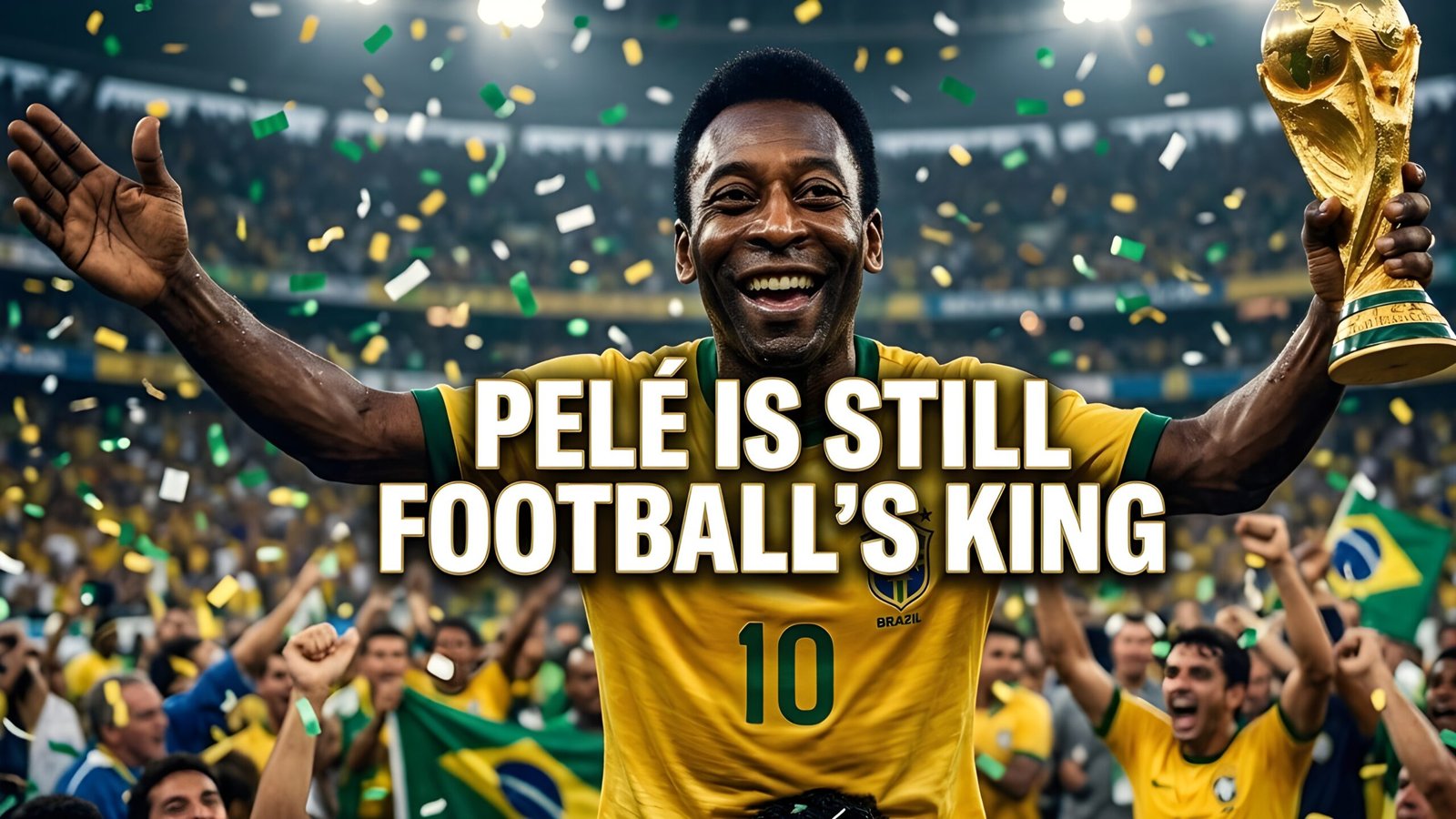
Pelé Is Still Football’s King—Here’s Why No One Has Truly Replaced Him
In the vast cathedral of world football, one name echoes above all others. Decades after his last competitive kick, Pelé Is Still Football’s King — not merely by sentiment, but by every measurable and immeasurable standard the sport has ever known. He was not simply a great player. He was the event horizon around which the entire history of football bends. To understand why, we must travel back to a barefoot boy in Bauru, Brazil, who would grow up to redefine what human beings could do with a ball.
How Did Pelé Earn the Title “O Rei” and Become Football’s King?
The nickname “O Rei” — The King — was not handed to Pelé by a marketing agency. It was a title pressed upon him by terraces full of people who had no other word large enough. The coronation happened organically, match by match, goal by goal, across stadiums from São Paulo to Stockholm.
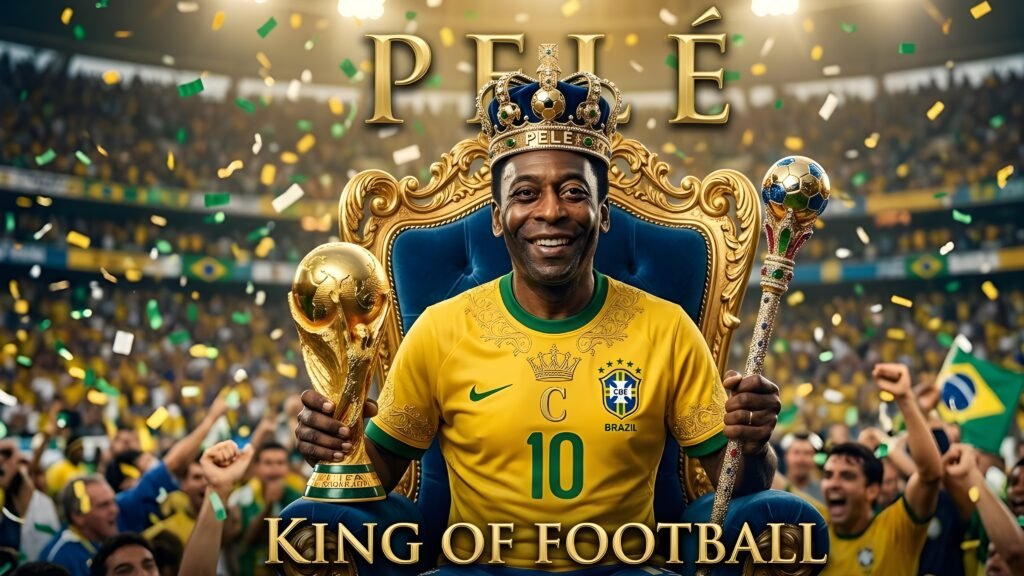
The moment that first stitched the word “king” to his name came in 1958, at the World Cup in Sweden. Pelé was seventeen years old. When Brazil lifted the trophy, the image of him weeping on the shoulder of his teammate Djalma Santos — overwhelmed by joy too enormous to contain — became one of the most reproduced photographs in sporting history.
The world saw a boy who had already become a legend, and the Brazilian press immediately began reaching for royal vocabulary. By the early 1960s, “O Rei” was simply what you called him, the way you might say “the sun” rather than “that glowing star.”
What reinforced the title was longevity. While other footballers burned brightly and faded, Pelé held his throne for nearly two decades, remaining not just relevant but dominant. Pelé Is Still Football’s King because a true king does not reign for a season — he reigns for an era.
How Did Pelé Win 3 World Cups—And Why Has No One Matched It Since?
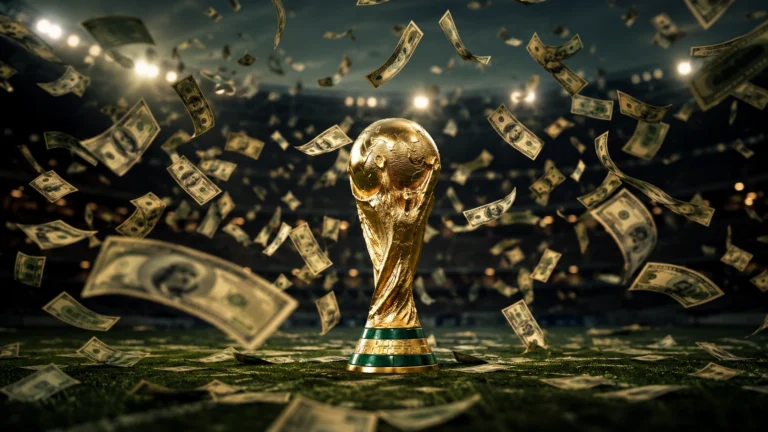
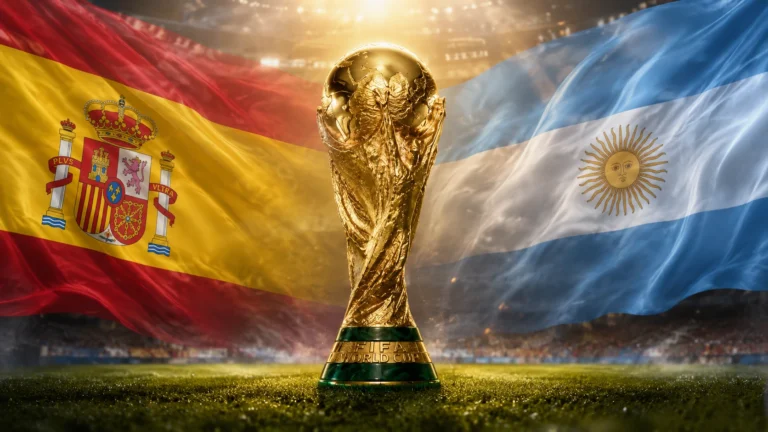
There is a simple, brutal fact that separates Pelé from every footballer who has ever laced a boot: he won the FIFA World Cup three times. In 1958 (Sweden), 1962 (Chile), and 1970 (Mexico), Brazil’s golden number ten collected the Jules Rimet Trophy. No other player in history has done this, and given the structure of modern international football — with the tournament occurring every four years and elite careers lasting roughly twelve to fifteen years at peak — it is extraordinarily unlikely anyone ever will.
To appreciate how rare this is, consider the following:
| Player | World Cups Won | Years Active (International) |
|---|---|---|
| Pelé | 3 (1958, 1962, 1970) | 1957–1971 |
| Ronaldo (Brazil) | 2 (1994, 2002) | 1994–2006 |
| Zinedine Zidane | 1 (1998) | 1994–2006 |
| Lionel Messi | 1 (2022) | 2005–present |
| Cristiano Ronaldo | 0 | 2003–present |
When people debate Messi and Cristiano Ronaldo, their most passionate defenders argue about Champions League medals, Ballon d’Or trophies, and league titles. Yet neither has matched even two World Cup victories. Pelé won three. He was injured for much of the 1962 tournament, yet Brazil still won — a testament to the infrastructure of excellence he had helped build around the national team. In 1970, he was arguably at his artistic peak, delivering a performance in the final against Italy that many historians of the game describe as the finest individual display in World Cup history.
Compared to modern legends, the 1970 campaign is particularly striking. That Brazil team — featuring Pelé, Jairzinho, Rivelino, Tostão, and Carlos Alberto — is routinely voted the greatest international side ever assembled. Their football was not merely effective; it was beautiful, theatrical, and humane. This is why Pelé Is Still Football’s King when the conversation turns to international supremacy: nobody else has three.
How Did a 17-Year-Old Pelé Rewrite Football History at the 1958 World Cup?
No story of Pelé can bypass 1958. He arrived at the tournament in Sweden as the youngest player in the competition — seventeen years and 239 days old. He left as a global superstar who had scored six goals, including a hat-trick in the semi-final against France and two in the final against the host nation.
The numbers alone do not capture the texture of what he did. In an era before satellite television and global broadcasting, word of this Brazilian teenager spread across Europe in hours, purely through the stunned testimonies of journalists and supporters who had watched him in person. His goals were not lucky strikes or tidy tap-ins. They were acrobatic, instinctive, almost impossible — shaped by years of playing futsal and street football in conditions of poverty that would have broken lesser spirits.
His youth mattered enormously for his legacy. Because he exploded onto the world stage at seventeen, he had the luxury of time. Fans across multiple generations — people who were children in 1958, adults in 1970, and elderly by the time he retired — all had a personal memory of Pelé at his peak. That generational span created a depth of affection and reverence that no player who debuted at twenty-two or twenty-three could replicate. It is one of the central reasons Pelé Is Still Football’s King in the emotional memory of the global game.
Are Pelé’s Goal Records Real? Stats, Context, and the Truth Explained
The question of Pelé’s goals is one of football’s great debates, complicated by record-keeping in the 1950s and 60s. FIFA officially credits him with 1,281 goals in 1,363 appearances across all competitions, though some statisticians apply stricter criteria and arrive at a lower figure. Even the most conservative tallies place him among the highest scorers in football history.
| Metric | Pelé | Cristiano Ronaldo | Lionel Messi |
|---|---|---|---|
| Career goals (all competitions) | ~1,281 | ~900+ | ~870+ |
| International goals | 77 (in 92 games) | 135 | 112 |
| World Cup goals | 12 | 8 | 13 |
| Goals per game (club career) | ~1.0 | ~0.7 | ~0.78 |
| Peak age | 17–30 | 22–38 | 21–36 |
Note: Figures for Ronaldo and Messi are approximate as of 2026; Pelé’s totals include unofficial and friendly matches.
What the table reveals is that Pelé’s goals-per-game ratio across his entire Santos career — roughly one goal per match — is a figure no modern player has consistently replicated over a comparable span. Messi and Ronaldo have each had extraordinary individual seasons that rival Pelé’s best, but the sustained average over nearly two decades of competitive football remains extraordinary.
Critics rightly note that Pelé played in an era before the hyper-competitive defensive structures of modern football, and that Brazilian league standards were not equivalent to La Liga or the Premier League of today. These are fair caveats. But they cut both ways: Pelé achieved everything he achieved without the benefit of sports science, GPS tracking, optimised nutrition, or recovery technology. The argument that Pelé Is Still Football’s King statistically is not based on naive nostalgia — it is grounded in the stubborn elegance of his numbers.
How Did Pelé Turn Football Into a Truly Global Game?
Santos Football Club, under Pelé’s gravitational pull, became the first truly global football brand. In the 1960s, Santos undertook exhibition tours across Africa, Asia, Europe, and the Americas — not because a television rights deal demanded it, but because governments and football federations around the world were desperate to have their people see Pelé in person.
Nigeria famously declared a 48-hour ceasefire during a civil war in 1967 so that both sides could watch him play. Whether apocryphal or not, this story has been repeated so often because it captures something genuinely true about his cultural impact.
His move to the New York Cosmos in 1975 was arguably the most strategically important transfer in football history — not for Santos or Brazil, but for the United States. He played there until 1977, and in those three years, the North American Soccer League’s attendance figures increased dramatically, American children began playing football in numbers previously unimaginable, and the cultural groundwork for the 1994 World Cup on US soil was quietly being laid.
The phrase “The Beautiful Game” — O Jogo Bonito — is most consistently attributed to Pelé. He used it to describe a philosophy of football that prioritised creativity, joy, and aesthetic ambition alongside competitive victory. In his hands, it was not a marketing slogan. It was a manifesto. Pelé Is Still Football’s King. This idea, the belief that football should be beautiful, not merely efficient, remains the soul of the sport’s global appeal.
How Did Pelé Become More Than a Player—A Global Icon and Political Symbol?
No footballer before or since has occupied the cultural and political space that Pelé claimed almost inadvertently. He became Brazil’s unofficial ambassador to the world at a time when the country was struggling to define its identity on the global stage. His blackness, his poverty-to-greatness narrative, and his extraordinary talent combined to make him a figure of immense symbolic power in a nation navigating questions of race, class, and national pride.
He served as Brazil’s Extraordinary Minister for Sport in the 1990s, where he was instrumental in drafting the Lei Pelé — a landmark piece of sports legislation that restructured professional football contracts and gave players greater rights. He worked with UNESCO as a goodwill ambassador. He appeared on the covers of Time magazine, participated in United Nations initiatives, and lent his name and presence to causes ranging from poverty reduction to environmental awareness.
For Brazilian children growing up in the favelas, as Pelé himself had been — he was proof of the possibility. His story was not abstract inspiration; it was concrete evidence that talent and determination could carry a person from nothing to everywhere. Pelé Is Still Football’s King in this regard, too: no footballer has ever wielded comparable soft power across culture, politics, and global branding.
Why Does Every GOAT Debate Still Come Back to Pelé?
Ask any serious football journalist why discussions of Messi versus Cristiano Ronaldo inevitably invoke Pelé, and they will give you the same answer: he is the fixed point. When we want to measure greatness in football, we reach for the most complete example of it, and that example has always been Pelé.
FIFA has responded to this reality in multiple ways. In 2000, he was jointly awarded FIFA Player of the Century alongside Maradona — an acknowledgement that the governing body of the sport itself recognised him as the unscalable standard. His record, his breadth of achievement, and his transformation of the sport into a global spectacle are woven into how FIFA defines excellence.
The Messi-Ronaldo debate is, in many ways, a debate about who can come closest to Pelé. Every milestone achieved — a World Cup, a goal record, a generational dominance — is measured against him first. This is precisely what it means to be the king. You do not chase the king. The king is what everyone else is chasing.
Pelé Is Still Football’s King in the architecture of how the sport talks about itself, how the media frames greatness, and how FIFA constructs its own mythology.
Would Pelé Dominate in Today’s Football—or Struggle in the Modern Era?
The counterfactual is irresistible: put Pelé in 2026, with modern boots, modern pitches, modern nutrition, and modern opposition — would he still be the king?
The honest answer requires separating two questions. Would his physical attributes translate? Almost certainly yes. At 5’8″ and built with explosive power and extraordinary balance, he matches the profile of elite modern forwards. His low centre of gravity, pace over short distances, and ambidexterity are attributes that modern coaches actively search for in the transfer market. Players like Neymar, Ronaldo Nazário, and even Messi share physical DNA with the young Pelé.
| Attribute | Pelé (Historical) | Modern Equivalent Needed |
|---|---|---|
| Pace (short burst) | Elite | Yes — still elite |
| Technical skill | World-class | Yes — timeless |
| Physical strength | Strong for era | Would need adaptation |
| Tactical awareness | Intuitive | Would benefit from coaching |
| Mental resilience | Exceptional | Yes — evident throughout career |
Would his style fit modern tactics? This is more nuanced. The 1970 Brazil played in a free, flowing 4-2-4 that gave forwards enormous space. Modern football’s high pressing, compact defensive blocks, and positional rigidity would have asked different questions of him. But every analyst who has engaged with this question seriously — from Johan Cruyff, who played against him, to modern coaches like Pep Guardiola who have spoken about him — arrives at the same conclusion: a player of Pelé’s intelligence and adaptability would simply have evolved.
Pelé Is Still Football’s King as a counterfactual proposition because his tools — pace, technique, vision, finishing, heading, and the almost supernatural ability to produce the decisive action in the decisive moment — are not products of his era. They are products of him.
Conclusion: The Crown That Never Passes
There is a difference between being the greatest player of your time and being the greatest player of all time. Many footballers have achieved the former. The argument for the latter has always rested most comfortably on Pelé’s shoulders.
He won three World Cups. He scored at a rate no modern star has matched. He globalised the sport, politicised his platform responsibly, and transformed a barefoot childhood in poverty into the most glittering career football has ever seen. He made the sport beautiful — not just tactically or statistically, but philosophically.
When Pelé passed away in December 2022, football did not move on. It paused. Stadiums around the world fell silent. Players who had never seen him play in real time wept openly on pitches in Europe, South America, and Asia. That is not what happens when a great player dies. That is what happens when a king does.
Pelé Is Still Football’s King — in the record books, in the cultural memory of billions, in the dreams of children kicking tin cans in the streets of Rio and Mumbai and Lagos. Every generation of football produces its genius. Only one era produced its king. And a king, by definition, reigns forever.
“The more difficult the victory, the greater the happiness in winning.” — Pelé

I’m a football writer, covering top leagues like the Premier League, La Liga, Bundesliga, Serie A, and Ligue 1. I write about match analysis, football news, tactics, and major tournaments such as the FIFA World Cup, delivering clear, engaging insights for fans.
About The Author
3 thoughts on “Why Pelé Is Still Football’s King Even Today”