
How Much Is the FIFA World Cup Trophy Worth? The Shocking Real Value
Every four years, billions of people around the world stop everything to watch the greatest football tournament on Earth. Yet while millions cheer for their teams and celebrate the victories, very few stop to wonder about the golden prize at the center of it all. The FIFA World Cup Trophy is arguably the most recognizable sporting award on the planet — a gleaming symbol of football supremacy that drives nations to compete for decades.
But what is it actually made of? How much does it cost to produce? And who gets to take it home? Whether you are a lifelong football fan or simply curious about the golden artifact that champions hoist above their heads in tears and triumph, this article breaks down everything you need to know — from its gold composition and manufacturing cost to its fascinating and sometimes troubled history.
What Is the FIFA World Cup Trophy Made Of and How Much Gold Does It Contain?
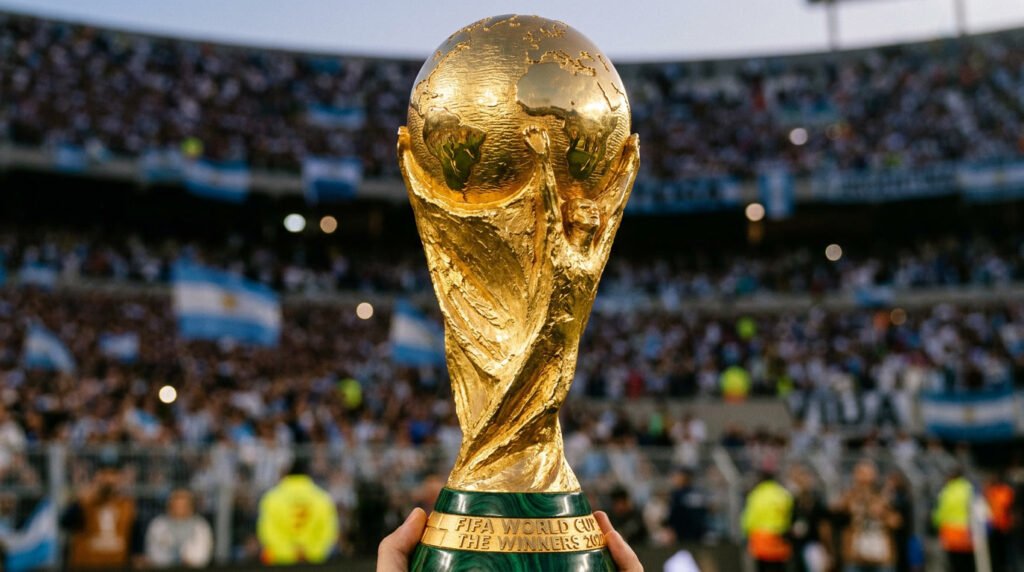
The FIFA World Cup Trophy is crafted from 18-carat solid gold — not the purest form, but a deliberate choice. Pure 24-carat gold, while more valuable, is too soft and malleable for a structural object meant to be handled, traveled with, and displayed across decades. The 18-carat composition provides the ideal balance of richness and durability.
Here is a breakdown of the trophy’s physical composition:
| Feature | Detail |
|---|---|
| Material | 18-carat solid gold |
| Weight | 6.175 kg (13.6 pounds) |
| Height | 36.8 cm (14.5 inches) |
| Base Material | Two layers of malachite (semi-precious stone) |
| Designer | Silvio Gazzaniga (Italian sculptor) |
| Year of Design | 1974 |
The trophy depicts two human figures with arms raised, holding up the Earth — a powerful visual metaphor for global unity through the sport of football. The malachite base adds both elegance and stability, giving the piece a grounded, ceremonial quality fitting for the world’s biggest prize.
Of the total weight, approximately 4.97 kilograms is estimated to be pure gold content, with the remainder accounted for by the base layers and internal structural elements. Understanding this composition is key to understanding why the FIFA World Cup Trophy carries such enormous monetary and symbolic worth.
Who Gets to Keep the FIFA World Cup Trophy After Winning the Tournament?
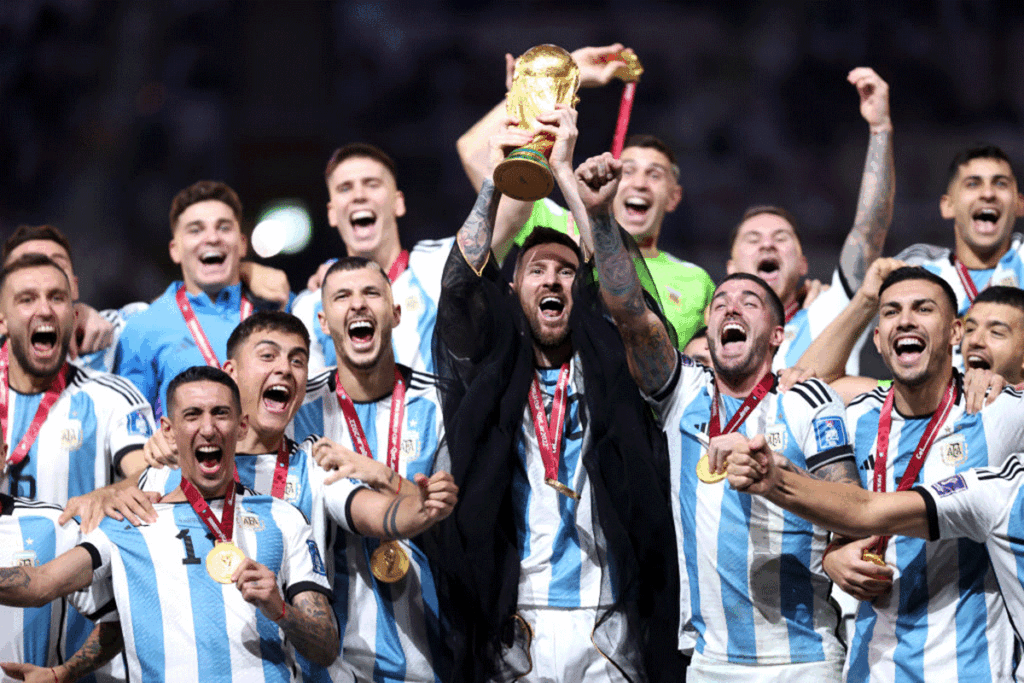
Here is a fact that surprises many fans: the winning team does not actually get to keep the original FIFA World Cup Trophy. This is one of FIFA’s most firmly held policies, and it exists for very good reason.
During the award ceremony immediately after the final, the winning captain lifts the authentic trophy — the real, original artifact. The celebrations, the photographs, the iconic moment of triumph — all of that happens with the genuine piece. However, within a short period after the ceremony, the trophy is returned to FIFA’s custody.
What the winning team actually receives to keep permanently is a gold-plated replica, crafted to the same dimensions and design as the original. These replicas are not cheap imitations — they are high-quality reproductions produced by FIFA specifically for this purpose.
| What the Champion Gets | Details |
|---|---|
| During Ceremony | The original, authentic trophy |
| To Keep Permanently | A gold-plated bronze replica |
| Display Options | National museum, football federation HQ |
| Original Trophy Custody | Returns to FIFA after the tournament |
FIFA maintains this policy for two core reasons: to protect an irreplaceable historical artifact, and to preserve the trophy as the singular, continuous symbol of World Cup history across all editions of the tournament. Champions proudly display their replicas in national museums and federation headquarters, where they serve as lasting monuments to the achievement.
What Happened to the Original FIFA World Cup Trophy (Jules Rimet Trophy)?
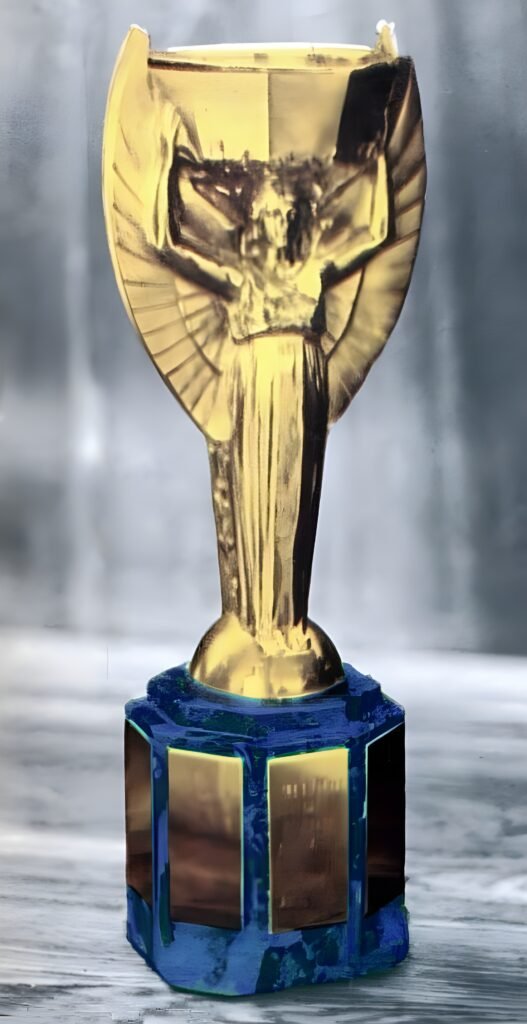
Before the current design, there was another trophy entirely — and its story is one of the most dramatic in sporting history. The Jules Rimet Trophy, named after FIFA president Jules Rimet, who founded the tournament in 1930, served as the World Cup prize for forty years, from 1930 to 1970.
The original Jules Rimet Trophy was a very different object: a small, winged figure of Nike, the Greek goddess of victory, crafted from gold-plated sterling silver and standing just 35 centimeters tall.
FIFA had a now-famous rule attached to it: any nation that won the World Cup three times would earn the right to keep the trophy permanently. Brazil, the most successful team in tournament history, achieved this milestone in 1970, claiming their third title in Mexico and earning the Jules Rimet Trophy as their permanent property.
| Jules Rimet Trophy Timeline | Event |
|---|---|
| 1930 | First awarded at the inaugural World Cup in Uruguay |
| 1966 | Stolen in England before the tournament; recovered by a dog named Pickles |
| 1970 | Permanently awarded to Brazil after their third World Cup title |
| 1983 | Stolen from the Brazilian Football Confederation in Rio de Janeiro |
| Post-1983 | Never recovered; believed to have been melted down |
The theft in 1983 was a genuine tragedy for football history. The trophy was taken from a glass case at the Brazilian Football Confederation headquarters and was never seen again. Most historians and investigators believe it was melted down and sold as raw gold — an ignoble end for one of sport’s most storied artifacts.
This incident sent a clear message to FIFA: the modern FIFA World Cup Trophy needed to be protected with far greater care and security, a standard that has been rigorously maintained ever since.
How Much Does It Cost to Make the FIFA World Cup Trophy Today?
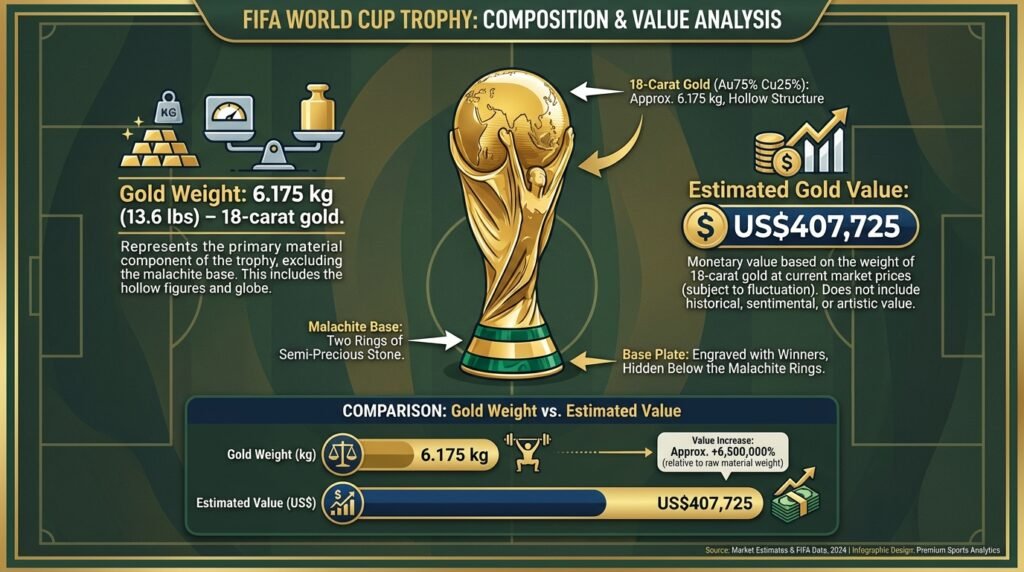
The manufacturing cost of the FIFA World Cup Trophy is surprisingly modest compared to its perceived worth. Based on gold market prices, the raw material value of the 18-carat gold used in the trophy is worth approximately US$407,725 — significant, but hardly reflective of what the trophy truly represents.
The real, total estimated value of the trophy is widely cited at over $20 million, driven by factors that go far beyond raw material cost:
| Value Component | Estimated Contribution |
|---|---|
| Raw gold content | US$407,725 |
| Craftsmanship and design | Significant premium |
| Historical and cultural significance | Largest value driver |
| Exclusivity (one of a kind) | Incalculable |
| Total Estimated Value | $20 million |
The manufacturing process itself is a work of art. The trophy is handcrafted using traditional techniques, including gold casting, precision sculpting, surface polishing, and the engraving of each winning nation’s name on the base. Italian sculptor Silvio Gazzaniga designed it in 1974, and his original vision has remained entirely intact through every edition of the tournament since. Gazzaniga described the figures as representing “the joy of victory” — humanity at its most triumphant, reaching upward together.
The craftsmanship premium is substantial. This is not a mass-produced item; it is a singular, handmade object created with the kind of meticulous attention to detail usually reserved for fine art and royal artifacts.
How Much Prize Money Does the FIFA World Cup Winner Receive Compared to the Trophy’s Value?
[Image suggestion: Graphic showing prize money breakdown across World Cup editions]
As magnificent as the FIFA World Cup Trophy is, the financial rewards that accompany a World Cup victory are even more staggering in pure monetary terms. At recent editions of the tournament, FIFA has awarded the champion nation approximately $50 million in prize money — a figure that dwarfs even the most generous estimates of the trophy’s manufacturing cost.
| World Cup Prize Money (Recent Editions) | Amount |
|---|---|
| Champion | ~$50 million |
| Runner-up | ~$33 million |
| Third Place | ~$29 million |
| Group Stage Exit | ~$9 million |
This prize money flows through national football federations, which then distribute portions to players as bonuses, reinvest in development programs, and support the broader football infrastructure of their country.
Yet for the players themselves, the financial reward is almost always secondary. Footballers who have won the FIFA World Cup consistently describe it as the single greatest moment of their careers — surpassing club trophies, individual awards, and even personal milestones. The trophy is the tangible crystallization of that feeling: something you can hold, photograph, and pass down through football history.
Conclusion
The FIFA World Cup Trophy is far more than gold and craftsmanship. It costs hundreds of thousands of dollars to produce in raw material terms, but its true value — estimated at over $20 million — is rooted in history, meaning, and the weight of everything it represents. Crafted from 18-carat gold with a design that speaks to global unity, the trophy has witnessed nearly a century of football’s greatest moments.
Winning teams receive only a replica to keep, while the original remains in FIFA’s careful custody — a lesson learned partly from the heartbreaking loss of the Jules Rimet Trophy in 1983. In the end, no price tag can fully capture what the FIFA World Cup Trophy means to the players who lift it, the nations that celebrate it, and the billions of fans who watch that moment and dream.
FAQs
Do World Cup winners keep the original trophy?
No. The winning team receives the original trophy during the ceremony but must return it to FIFA. They are later awarded an official gold-plated replica.
Who designed the FIFA World Cup trophy?
The current trophy was designed by Italian sculptor Silvio Gazzaniga in 1974. The design shows two human figures lifting the Earth, symbolizing global unity through football.
What happened to the Jules Rimet Trophy?
The Jules Rimet Trophy, used from 1930 to 1970, was permanently awarded to Brazil after their third World Cup win. It was later stolen in 1983 and never recovered.
How much prize money does the FIFA World Cup winner receive?
Recent FIFA World Cup champions receive around $50 million in prize money, making it one of the most lucrative tournaments in international sports.