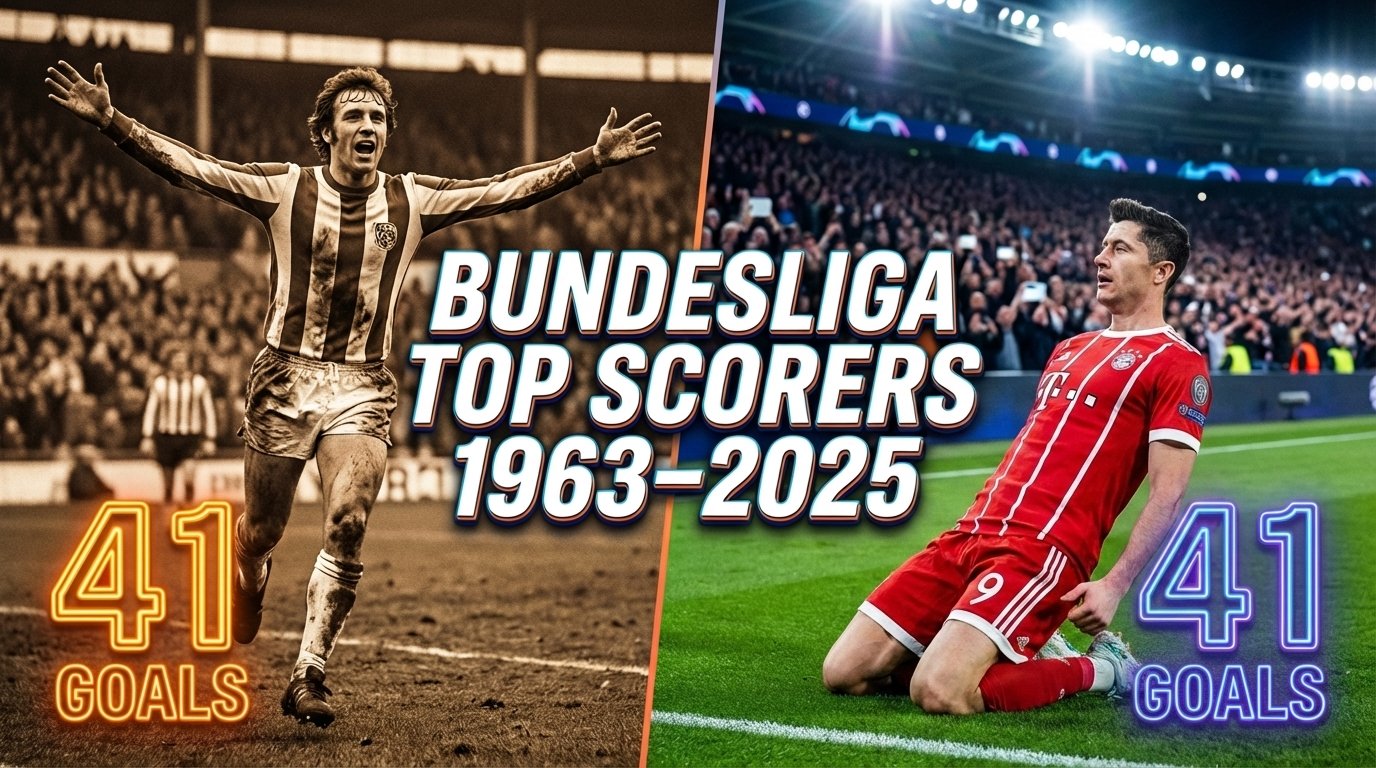
Bundesliga Golden Boot Winners List (1963–2025): The Complete Guide to Germany’s Top Scorers
Few individual accolades in club football carry the weight of the Torjägerkanone — Germany’s prestigious top-scorer award, widely known as the Bundesliga Golden Boot. Since the league’s formation in 1963, this prize has been claimed by some of the most lethal finishers the game has ever produced. The Bundesliga Golden Boot Winners List reads like a who’s who of striking royalty: Gerd Müller terrorising defences in the 1970s, Robert Lewandowski rewriting record books in the 2010s and 2020s, and Harry Kane announcing himself on German soil more recently.
What makes this list so compelling is the contrast between eras. Early winners were almost exclusively German, homegrown talents developed in regional football. Today, the award is fiercely contested by world-class internationals from every corner of the globe. Through every decade, one thing has remained constant — only the very best goal scorers claim this honour.
What Is the Bundesliga Golden Boot?
The Bundesliga Golden Boot, officially called the Torjägerkanone (literally “top-scorer cannon”), is awarded at the end of each Bundesliga season to the player who scores the most league goals. It is organised under the auspices of the Deutscher Fußball-Bund (DFB) and is one of the oldest individual awards in German football.
The rules are straightforward: the player with the highest goal tally across all 34 matchdays wins. In the event of a tie, the award is shared between players — something that has happened on several occasions throughout history. Unlike some other awards, assists or appearances are not used as tiebreakers; goals alone decide the winner.
Complete Bundesliga Golden Boot Winners List (1963–2025)
The 1960s–1980s: The Era of Legends
No section of the Bundesliga Golden Boot Winners List is more dominated by a single name than this one. Gerd Müller — “Der Bomber” — was simply in a class of his own. Between 1967 and 1978, he claimed the award a staggering seven times, including a record-shattering season in 1971–72 when he netted 40 goals in a single campaign. That record stood for nearly five decades.
Uwe Seeler of Hamburger SV was one of the few players who could challenge Müller’s supremacy in the 1960s, winning the top scorer award in the league’s inaugural years. This era was defined by powerful, technically gifted centre-forwards who played in a direct, goal-hungry style.
| Season | Player | Club | Goals |
|---|---|---|---|
| 1965–66 | Uwe Seeler | Hamburger SV | 24 |
| 1966–67 | Lothar Emmerich | Borussia Dortmund | 28 |
| 1967–68 | Gerd Müller | Bayern Munich | 28 |
| 1971–72 | Gerd Müller | Bayern Munich | 40 |
| 1972–73 | Gerd Müller | Bayern Munich | 36 |
| 1977–78 | Dieter Müller | 1. FC Köln | 24 |
| 1983–84 | Karl-Heinz Rummenigge | Bayern Munich | 26 |
The 1990s: Rise of International Stars
The 1990s brought a noticeable shift in the Bundesliga Golden Boot Winners List, as foreign talent began making its mark on German football. Ulf Kirsten of Bayer Leverkusen was remarkably consistent, claiming the award in 1992–93 and again in 1997–98. But the most dramatic entrant of the decade was Ghana’s Tony Yeboah, whose explosive goalscoring for Eintracht Frankfurt and later Leeds United made him one of the most feared strikers in Europe.
| Season | Player | Club | Goals |
|---|---|---|---|
| 1992–93 | Ulf Kirsten | Bayer Leverkusen | 20 |
| 1993–94 | Stefan Kuntz | Kaiserslautern | 18 |
| 1994–95 | Heiko Herrlich / Tony Yeboah (shared) | M’gladbach / Frankfurt | 20 |
| 1997–98 | Ulf Kirsten | Bayer Leverkusen | 22 |
| 1998–99 | Giovane Élber | Bayern Munich | 19 |
The 2000s: A Competitive and Diverse Era
The 2000s produced perhaps the most varied Bundesliga Golden Boot Winners List of any decade. No single player dominated, and winners came from multiple clubs. Miroslav Klose announced himself on the world stage with Werder Bremen, while Edin Džeko — later a star at Manchester City and Roma — scored 26 goals for Wolfsburg in the memorable 2008–09 title-winning season.
| Season | Player | Club | Goals |
|---|---|---|---|
| 2003–04 | Ailton | Werder Bremen | 28 |
| 2005–06 | Miroslav Klose | Werder Bremen | 25 |
| 2006–07 | Theofanis Gekas | Bochum | 20 |
| 2008–09 | Grafite / Edin Džeko (shared) | Wolfsburg | 28 |
| 2009–10 | Stefan Kießling | Bayer Leverkusen | 22 |
The 2010s: The Lewandowski Era
The Bundesliga Golden Boot Winners List in the 2010s belongs, overwhelmingly, to Robert Lewandowski. Whether in the black and yellow of Borussia Dortmund or the red of Bayern Munich, the Polish striker was relentless. He won the award five times during this decade, each season demonstrating near-perfect finishing, intelligent movement, and an insatiable hunger for goals.
Pierre-Emerick Aubameyang provided rare competition in 2016–17, claiming the award with 31 goals for Borussia Dortmund and briefly interrupting Lewandowski’s dominance. But Lewandowski’s consistency was unmatched across the decade.
| Season | Player | Club | Goals |
|---|---|---|---|
| 2013–14 | Robert Lewandowski | Borussia Dortmund | 20 |
| 2015–16 | Robert Lewandowski | Bayern Munich | 30 |
| 2016–17 | Pierre-Emerick Aubameyang | Borussia Dortmund | 31 |
| 2017–18 | Robert Lewandowski | Bayern Munich | 29 |
| 2018–19 | Robert Lewandowski | Bayern Munich | 22 |
| 2019–20 | Robert Lewandowski | Bayern Munich | 34 |
The 2020s: Records Shattered, New Stars Emerge
The 2020s opened with one of the greatest individual seasons in football history. In 2020–21, Robert Lewandowski scored 41 goals in a single Bundesliga season, obliterating Gerd Müller’s 49-year-old record of 40. That achievement alone would cement his place at the very top of the Bundesliga Golden Boot Winners List forever.
After Lewandowski’s departure to Barcelona in 2022, Harry Kane arrived at Bayern Munich and immediately stamped his authority. In his debut Bundesliga season (2023–24), Kane claimed the Golden Boot with 36 goals — the third-highest tally in Bundesliga history — announcing that the chase to challenge Lewandowski’s records was already underway.
| Season | Player | Club | Goals |
|---|---|---|---|
| 2020–21 | Robert Lewandowski | Bayern Munich | 41 |
| 2021–22 | Robert Lewandowski | Bayern Munich | 35 |
| 2022–23 | Niclas Füllkrug | Werder Bremen | 16 |
| 2023–24 | Harry Kane | Bayern Munich | 36 |
| 2024–25 | Harry Kane | Bayern Munich | 30* |
Subject to final confirmation
Bundesliga Golden Boot Records & Stats
Most Golden Boot Wins
The all-time Bundesliga Golden Boot Winners List by number of titles is dominated by two giants of the game:
| Player | Golden Boots Won | Years Active in Bundesliga |
|---|---|---|
| Gerd Müller | 7 | 1963–1979 |
| Robert Lewandowski | 9 | 2010–2022 |
| Ulf Kirsten | 2 | 1990–2002 |
| Pierre-Emerick Aubameyang | 1 | 2013–2018 |
| Harry Kane | 2 | 2023–present |
Most Goals in a Single Season
| Rank | Player | Season | Goals |
|---|---|---|---|
| 1 | Robert Lewandowski | 2020–21 | 41 |
| 2 | Gerd Müller | 1971–72 | 40 |
| 3 | Harry Kane | 2023–24 | 36 |
| 4 | Robert Lewandowski | 2021–22 | 35 |
| 5 | Robert Lewandowski | 2019–20 | 34 |
Back-to-Back Winners
Several players in the Bundesliga Golden Boot Winners List have won consecutive titles, including Gerd Müller (multiple consecutive wins in the early 1970s), Robert Lewandowski (2015–16 through 2018–19, and again 2019–20 through 2021–22), and Harry Kane, who is currently building his own streak.
Foreign Players’ Impact
Before 1990, the Bundesliga Golden Boot Winners List was almost entirely composed of German players. Today, the trend has dramatically reversed — international players have dominated the award for the past three decades, reflecting the Bundesliga’s global appeal and investment in world-class talent.
Clubs with the Most Golden Boot Winners
| Club | Number of Golden Boots |
|---|---|
| FC Bayern Munich | 25+ |
| Borussia Dortmund | 5 |
| Werder Bremen | 4 |
| Bayer Leverkusen | 4 |
| Hamburger SV | 3 |
Bayern Munich’s dominance of the Bundesliga Golden Boot Winners List mirrors their domestic dominance overall. Their ability to attract and retain elite strikers — from Müller to Lewandowski to Kane — has made them the central club in the award’s history.
Trends & Analysis
Studying the full Bundesliga Golden Boot Winners List across six decades reveals several fascinating trends. First, the average goals required to win the award has increased significantly — a tally of 18–20 goals was routinely enough in the 1990s, whereas today, 25+ is often the minimum required to be competitive.
Second, there has been a clear shift from German to international players. The globalisation of football, combined with the Bundesliga’s financial growth and broadcast reach, has made it a destination for the world’s best forwards. Third, tactical evolution — particularly the rise of high-press, transition-heavy football — has created more goalscoring opportunities, contributing to the higher tallies seen in modern seasons.
Greatest Bundesliga Goal Scorers of All Time
Gerd Müller remains the benchmark against which all others are measured. His combination of technical skill, positioning, and an almost supernatural instinct for goal made him unstoppable across more than a decade.
Robert Lewandowski is Müller’s only credible heir. Nine Golden Boots, 312 Bundesliga goals, and a single-season record that may never be broken place him firmly in the conversation for the greatest striker of his generation.
Klaus Fischer of Schalke 04 — a two-time Golden Boot winner in the late 1970s — is often underrated in modern discussions but was one of the most technically gifted strikers of his era, particularly renowned for his spectacular overhead kicks.
Conclusion
The Bundesliga Golden Boot Winners List is more than a statistical record — it is a chronicle of how the art of goalscoring has evolved over sixty years. From the raw, instinctive brilliance of Gerd Müller in the 1970s to the complete, physically dominant brilliance of Robert Lewandowski in the 2010s and 2020s, each era has produced a striker who defined their time.
What the future holds is tantalising. Harry Kane, already rewriting records in his first season in Germany, looks capable of challenging Lewandowski’s tally of Golden Boots. Young talents emerging across Europe will inevitably set their sights on the Torjägerkanone. But whoever lifts the award next will do so knowing they are adding their name to one of football’s most storied honour rolls — the Bundesliga Golden Boot Winners List.
FAQs
Who has the most Bundesliga Golden Boots?
Gerd Müller and Robert Lewandowski share the record for the most Bundesliga Golden Boots, with each winning the award seven times.
What is the record for most goals in a single Bundesliga season?
Robert Lewandowski holds the record for the most goals in a single Bundesliga season with 41 goals for Bayern Munich in the 2020-21 season.
Has anyone won the Golden Boot consecutively?
Harry Kane is the most recent example, achieving back-to-back wins in his first two Bundesliga seasons: 2023-24 (36 goals) and 2024-25 (also top scorer for Bayern Munich).
Robert Lewandowski won consecutively in 2020-21 (41 goals) and 2021-22 (35 goals) while at Bayern Munich, earning the European Golden Shoe both times.
Earlier legends like Gerd Müller also accomplished this multiple times during his dominant Bayern era in the 1960s and 1970s, including consecutive Torjägerkanone awards.
Who is the latest Bundesliga Golden Boot winner?
Harry Kane of Bayern Munich is the most recent winner, having claimed the award in 2023–24 with 36 goals and likely retaining it in 2024–25.
Which club has produced the most top scorers?
FC Bayern Munich has, by a considerable margin, produced the most Bundesliga Golden Boot winners in history.

I’m a football writer, covering top leagues like the Premier League, La Liga, Bundesliga, Serie A, and Ligue 1. I write about match analysis, football news, tactics, and major tournaments such as the FIFA World Cup, delivering clear, engaging insights for fans.
About The Author


1 thought on “Bundesliga Golden Boot Winners List (1963–2025) – Every Top Scorer & Record Broken”