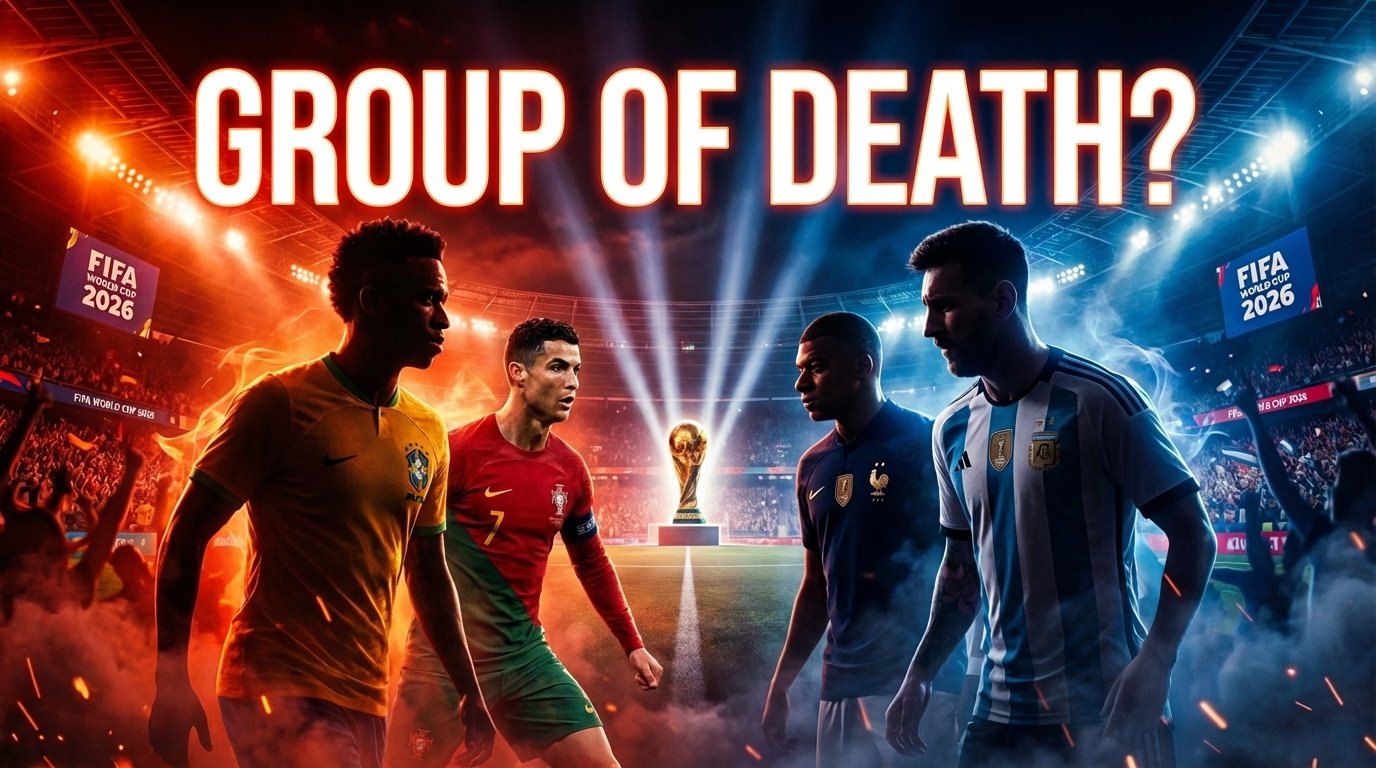
The Possible “Group of Death” in FIFA World Cup 2026 That Nobody Saw Coming
Imagine 48 nations, three host countries, 104 matches, and one trophy. The FIFA World Cup 2026 is shaping up to be the most spectacular football event in history — and it hasn’t even kicked off yet. But while most fans were glued to the big-name groups featuring Argentina, Brazil, Spain, and France, one particular group quietly assembled itself into an absolute minefield.
Nobody saw it coming. And that’s what makes it so deliciously dangerous.
For the first time ever, 48 teams will compete in the World Cup, spread across 12 groups instead of the familiar eight. The expanded format has thrown traditional predictions out the window. In a tournament this big, there’s more room for chaos — and chaos, it turns out, found a very specific address.
Before we reveal the Group of Death that’s got analysts scrambling and fans arguing on X (formerly Twitter), let’s set the scene.
FIFA World Cup 2026 Overview
When Will the FIFA World Cup 2026 Start?
Mark your calendars. The FIFA World Cup 2026 officially kicks off on June 11, 2026, with Mexico hosting the tournament’s opening match against South Africa at the iconic Estadio Azteca in Mexico City. The final will be played on July 19, 2026, at MetLife Stadium in East Rutherford, New Jersey — home of the New York Giants and New York Jets.
That’s 39 days of pure footballing madness.
The tournament is jointly hosted by three nations: the United States, Canada, and Mexico — the first World Cup ever to be co-hosted by three countries, and the largest in the competition’s 96-year history. Matches will be held across 16 cities, with 11 in the USA, 3 in Mexico, and 2 in Canada. The majority of the 104 total matches — 78 of them — will be played in the United States.
How Many Teams Have Qualified for the World Cup 2026?
This is where everything changes. For the very first time, 48 teams are competing in the World Cup, up from the 32-team format used since 1998. That’s a 50% increase in participating nations.
| Format Era | Number of Teams | Number of Groups |
|---|---|---|
| 1930–1974 | 8–16 | Varies |
| 1982–1994 | 24 | 6 groups of 4 |
| 1998–2022 | 32 | 8 groups of 4 |
| 2026 onward | 48 | 12 groups of 4 |
This expansion means more nations have a chance at football’s biggest stage — and more upsets waiting to happen.
How Do Teams Qualify for the FIFA World Cup 2026?
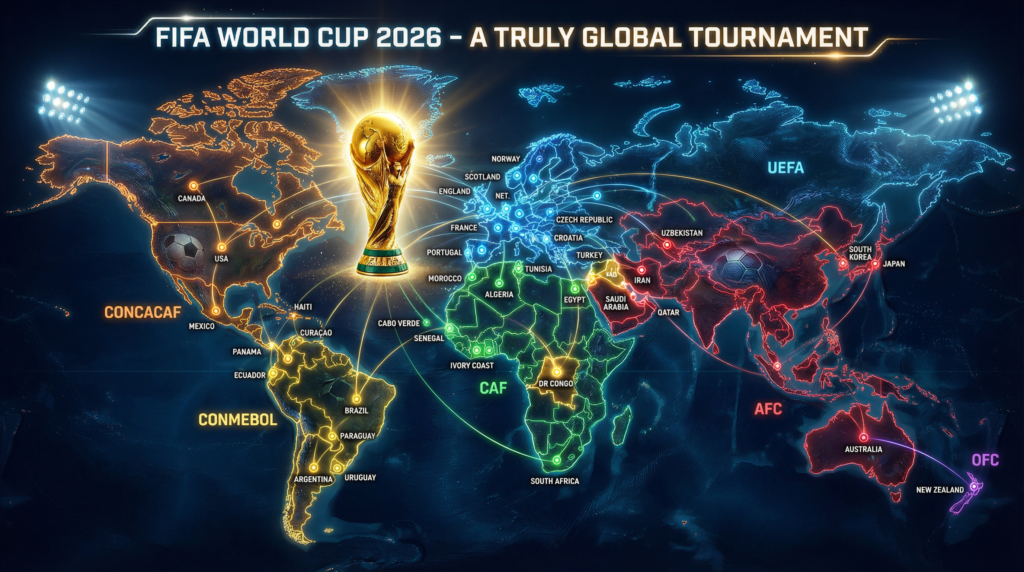
Qualification is run through FIFA’s six continental confederations, each allocated a set number of spots proportional to their football strength and membership:
- UEFA (Europe): 16 spots (12 direct + 4 via playoffs)
- CAF (Africa): 9 spots
- AFC (Asia): 8 spots
- CONMEBOL (South America): 6 spots
- CONCACAF (North/Central America): 6 spots (3 automatic hosts + 3 via qualifying)
- OFC (Oceania): 1 spot (guaranteed for the first time ever)
- Inter-confederation playoffs: 2 additional spots
Three nations — the USA, Canada, and Mexico — qualified automatically as co-hosts.
Which Teams Have Qualified for the FIFA World Cup 2026?
After months of qualifying drama, all 48 spots are now confirmed. Some of the final six places were decided in dramatic playoff fashion in March 2026.
| Confederation | Qualified Teams |
|---|---|
| UEFA (Europe) | England, France, Germany, Spain, Portugal, Netherlands, Belgium, Croatia, Austria, Switzerland, Norway, Scotland, Sweden, Turkey, Bosnia & Herzegovina, Czech Republic |
| CAF (Africa) | Morocco, Senegal, Egypt, Algeria, Ghana, Ivory Coast, Cabo Verde, South Africa, Tunisia, DR Congo |
| AFC (Asia) | Japan, South Korea, Australia, Iran, Saudi Arabia, Qatar, Jordan, Uzbekistan |
| CONMEBOL (S. America) | Argentina, Brazil, Colombia, Uruguay, Ecuador, Paraguay |
| CONCACAF (N. America) | USA, Mexico, Canada, Panama, Haiti, Curaçao |
| OFC (Oceania) | New Zealand |
| Inter-Confederation Playoffs | Iraq, DR Congo |
Notable firsts: Curaçao became the smallest nation ever to qualify for a World Cup. Cape Verde and Uzbekistan are making historic appearances. And for the first time in the World Cup’s history, all six confederations have at least one guaranteed berth.
FIFA World Cup 2026 Groups Explained
What Are the Groups for the FIFA World Cup 2026?
The groups run alphabetically from A through L — twelve groups, each containing four teams. The draw took place on December 5, 2025, at the Kennedy Centre in Washington, D.C., in a glitzy ceremony featuring Tom Brady, Shaquille O’Neal, Wayne Gretzky, Kevin Hart, and even the U.S. President.
Teams were seeded into four pots based on FIFA world rankings, with host nations automatically placed in Pot 1. The draw guaranteed that:
- Every group has one team from Pot 1 (top-ranked / hosts)
- No two teams from the same confederation end up in the same group (except UEFA, which may place two European teams in one group)
Will There Be a Round of 32 in the World Cup 2026?
Yes — and this is new. The knockout structure works as follows:
- The top 2 teams from each of the 12 groups advance automatically (24 teams)
- The 8 best third-place finishers across all 12 groups also advance (8 teams)
- That makes 32 teams entering the Round of 32
The knockout path from there: Round of 32 → Round of 16 → Quarterfinals → Semifinals → Final
FIFA also introduced a clever structural tweak for 2026: the top four-ranked teams (Spain, Argentina, France, England) were placed in opposite bracket pathways. This means if all four win their groups, they cannot meet until the semifinals at the earliest — building toward what could be an all-time epic final.
World Cup 2026 Group Stage Breakdown
Here’s the complete group stage breakdown, now that all 48 teams are confirmed:
| Group | Teams |
|---|---|
| A | Mexico, South Africa, South Korea, Czech Republic |
| B | Canada, Bosnia & Herzegovina, Qatar, Switzerland |
| C | Brazil, Morocco, Haiti, Scotland |
| D | USA, Paraguay, Australia, Turkey |
| E | Germany, Curaçao, Ivory Coast, Ecuador |
| F | Netherlands, Japan, Sweden, Tunisia |
| G | Belgium, Egypt, Iran, New Zealand |
| H | Spain, Cape Verde, Saudi Arabia, Uruguay |
| I | France, Senegal, Iraq, Norway |
| J | Argentina, Algeria, Austria, Jordan |
| K | Portugal, DR Congo, Uzbekistan, Colombia |
| L | England, Croatia, Ghana, Panama |
What Teams Are in Group A of the 2026 World Cup?
Mexico, South Africa, South Korea, and the Czech Republic
Group A is the opener — literally. Mexico vs. South Africa is the very first match of the tournament on June 11 at the Estadio Azteca. For Mexico, playing at home in front of a boisterous crowd should be a huge advantage. South Korea brings technical quality and World Cup experience (they famously reached the 2002 semifinals on home soil). The Czech Republic sneaked through the playoffs by eliminating Denmark on penalties. South Africa, while underdogs, will feed off the emotional connection to the 2010 tournament they hosted. Mexico should be the strong favourites here.
Which Teams Are in Group B of the FIFA World Cup 2026?
Canada, Bosnia & Herzegovina, Qatar, Switzerland
Canada plays their home opener at BMO Field in Toronto against Bosnia & Herzegovina — the playoffs’ biggest surprise story, having knocked out Italy. Switzerland is a consistent tournament performer that never goes quietly. Qatar, the 2022 hosts, will be determined to prove their first qualifying campaign was no fluke. Canada, riding the momentum of their golden generation (Alphonso Davies, Jonathan David), are heavy favourites but shouldn’t take Bosnia lightly.
Which World Cup 2026 Group Is the Hardest?
Several groups deserve special attention before we crown the toughest:
Group C (Brazil, Morocco, Haiti, Scotland) — Brazil are one of the tournament favourites, and Morocco is Africa’s gold standard right now. Scotland qualifying for their first World Cup since 1998 makes this a sentimental one. But Brazil vs. Morocco as an opening group fixture? That’s a potential blockbuster.
Group F (Netherlands, Japan, Sweden, Tunisia) — The Dutch, fresh from their Euro 2024 run, face Japan — arguably Asia’s most technically advanced team — and Sweden, who’ve been reborn under a new generation. This is nasty.
Group I (France, Senegal, Iraq, Norway) — France and Senegal in the same group? Flashbacks to 2002, when Senegal memorably knocked out France in the opening game. Add Norway and Erling Haaland into the mix, and suddenly Iraq — the last team to qualify — are watching three giants fight over two spots.
Group L (England, Croatia, Ghana, Panama) — England and Croatia have one of the most emotionally charged rivalries in recent World Cup history (2018 semifinal). Both will want this one badly.
The Hidden “Group of Death” in FIFA World Cup 2026
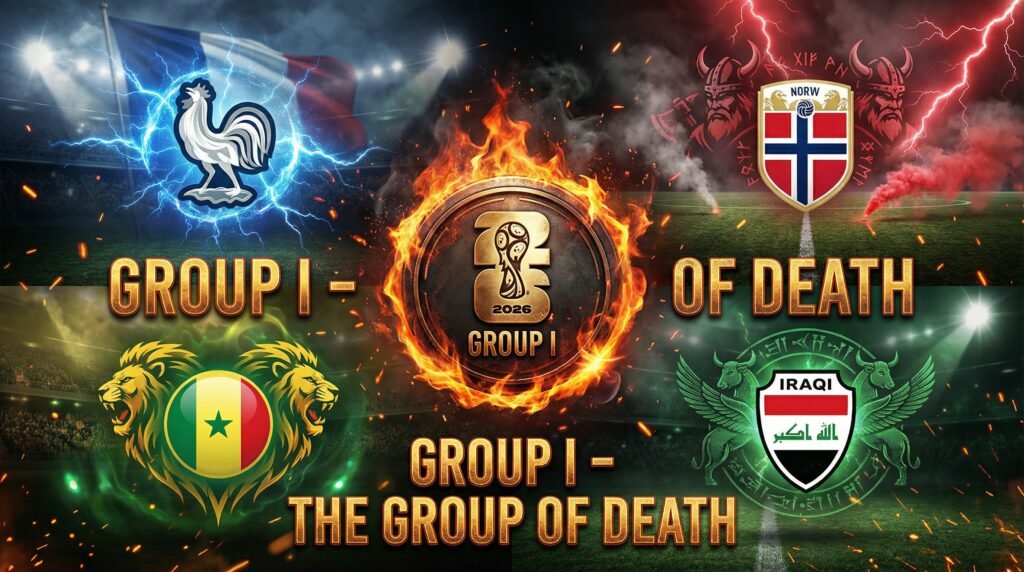
Which Group Is the “Group of Death” in the World Cup 2026?
While fans were busy arguing about Brazil vs. Morocco and England vs. Croatia, Group I quietly became the most brutal group in the tournament.
GROUP I: France 🇫🇷 | Senegal 🇸🇳 | Norway 🇳🇴 | Iraq 🇮🇶
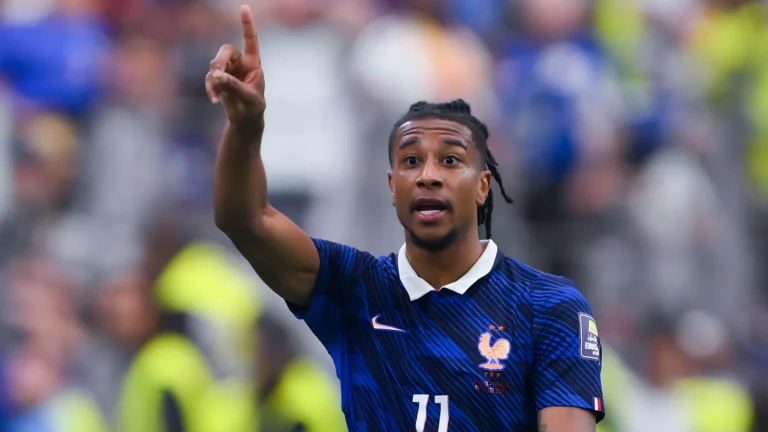
On paper, France is the strongest team. They’ve won the World Cup twice, reached the final in 2022, and are packed with elite talent. But the moment you add Senegal and Norway to that equation, “strong favourites” starts feeling like wishful thinking.
Senegal is the reigning Africa Cup of Nations champions, packed with Premier League stars, and historically dangerous against French sides. Sadio Mané’s career may be winding down, but players like Ismaila Sarr, Pape Matar Sarr, and Édouard Mendy make them a formidable unit. And again, they beat France in the 2002 World Cup. The historical scar runs deep.
Then there’s Norway. Erling Haaland. That name alone makes every coach in the world nervous. Norway are making their first World Cup appearance since 1998, and they’re arriving with arguably the world’s most lethal striker at the peak of his powers. They’ll be highly motivated, defensively organised, and physically dominant.
Iraq, the final team to secure qualification, are the relative wildcards — but don’t sleep on them. They qualified through the inter-confederation playoffs, defeating Bolivia to grab their spot. In a tournament where survival is the first goal, a team with nothing to lose can be the most dangerous kind.
| Team | FIFA Rank | Why They’re Dangerous |
|---|---|---|
| France | 3 | World-class across all positions, Mbappé, Griezmann, Camavinga |
| Senegal | 12 | AFCON champions, physically dominant, PSG-Mané legacy |
| Norway | 32 | Erling Haaland in World Cup debut, first appearance since 1998 |
| Iraq | 58 | Nothing to lose, organized defense, passionate support |
Why Fans Didn’t Expect This Group to Be So Brutal
When the draw happened in December 2025, most fans were focused on Group C (Brazil-Morocco) and Group F (Netherlands-Japan). Group I got relatively quiet coverage initially — France were there, so people assumed they’d cruise through.
Then analysts started doing the math.
France vs. Senegal is a rematch nobody wanted (unless you’re a neutral). Norway vs. France is Haaland vs. Mbappé — two of the world’s most marketable and lethal forwards on the same pitch. Senegal vs. Norway would be Africa’s finest versus the Viking revival. Every single match in this group has genuine consequences, genuine star power, and genuine upset potential.
Expert reaction after the draw: “Group I is going to be incredible,” said multiple football pundits. Others noted it was the group where a true favourite — France — could realistically finish third. That rarely happens to a team of France’s calibre.
Historically, the classic “Group of Death” label has gone to groups like the 2014 World Cup’s Group D (Uruguay, Costa Rica, England, Italy) or the 1982 Group of Death (West Germany, England, Spain). Group I 2026 belongs in that conversation.
Which Teams Have the Easiest Group in the 2026 World Cup?
Not every group is a battlefield. A few fortunate nations got very comfortable draws:
Germany (Group E: Germany, Curaçao, Ivory Coast, Ecuador) — This might be the most straightforward draw for a top-tier team in the whole tournament. Curaçao are making their World Cup debut. Ivory Coast and Ecuador are solid but not world-beaters. Germany, under Julian Nagelsmann, should win this group comfortably.
Argentina (Group J: Argentina, Algeria, Austria, Jordan) — The defending champions face a group that, while not a pushover, gives them a clear path to the Round of 32. Algeria are the biggest threat, but Argentina’s squad depth is immense.
Spain (Group H: Spain, Cape Verde, Saudi Arabia, Uruguay) — Spain is the FIFA world ranking leader coming into this tournament. Uruguay will test them — but Cape Verde and Saudi Arabia are manageable. Spain should win this group and arrive at the knockouts well-rested.
Early Favourites to Win the FIFA World Cup 2026
Which Team Has the Best Squad for the World Cup 2026?
Squad depth separates champions from contenders. Here’s how the favourites stack up:
| Team | Strengths | Key Players |
|---|---|---|
| Spain | Technical brilliance, pressing, consistency | Pedri, Yamal, Morata, Rodri |
| France | World-class depth in every position | Mbappé, Olise, Camavinga, Maignan |
| England | Premier League-hardened stars, physical quality | Bellingham, Saka, Kane, Alexander-Arnold |
| Brazil | Samba football returns, creative freedom | Vinícius Jr., Rodrygo, Endrick |
| Argentina | Defending champions, battle-hardened | Messi, Álvarez, Mac Allister |
Who Are the Favourites to Win the FIFA World Cup 2026?
Spain 🇪🇸 — According to BetMGM, Spain is the pre-tournament favourites at +400. The 2010 World Cup winners and 2024 European champions bring the deepest tactical system in international football.
England 🏴 — At +600, England is bullish. Jude Bellingham’s rise to global superstar status, Harry Kane’s goal-scoring consistency, and Gareth Southgate’s (or successor’s) structured approach make England a constant threat.
France 🇫🇷 — At +650, France carries the ever-present fear factor that Kylian Mbappé instils. When Mbappé is on form, France looks unbeatable.
Brazil 🇧🇷 — +750. The Seleção are always dangerous, but have gone two decades without a World Cup. The hunger is real. A Vinícius Jr. in full flow is terrifying.
Argentina 🇦🇷 — +800. The reigning champions. Post-Messi era planning has begun, but the core of the 2022 winners remains. Julian Álvarez and Enzo Fernández are world-class.
Underdog Teams to Watch in World Cup 2026
10 Underdog Teams to Watch in FIFA World Cup 2026
The expanded 48-team format is a dream for underdogs. More teams, more chaos. Here are 10 nations that could upset the established order:
| # | Team | Why They Could Surprise |
|---|---|---|
| 1 | Morocco 🇲🇦 | Reached 2022 semis, the first African team to do so; still talented and motivated |
| 2 | Japan 🇯🇵 | Creative attack, James Rodríguez is still influential, strong qualifying campaign |
| 3 | Canada 🇨🇦 | Playing on home soil with Alphonso Davies and Jonathan David in full form |
| 4 | Senegal 🇸🇳 | AFCON champions with a core of Premier League stars |
| 5 | Colombia 🇨🇴 | Master tacticians; reached the 2018 final and the 2022 third place |
| 6 | Croatia 🇭🇷 | First World Cup since 1998 — emotional, passionate, organised |
| 7 | Australia 🦘 | The Socceroos reached the 2022 quarters; don’t underestimate them again |
| 8 | Scotland 🏴 | Creative attack, James Rodríguez is still influential, strong, qualifying campaign |
| 9 | Uzbekistan 🇺🇿 | First-time qualifiers; unpredictable and technically improving rapidly |
| 10 | Curaçao 🇨🇼 | The smallest nation ever to qualify — their story alone is worth following |
Which Underdog Teams Could Surprise Everyone?
Morocco remains the dark horse to end all dark horses. Their 2022 run to the semifinals — eliminating Spain and Portugal along the way — was no fluke. Under their experienced defensive setup, they can neutralise anyone on a given day.
Japan are arguably no longer an underdog in the traditional sense. Their technical quality is world-class, their pressing is relentless, and they’ve embarrassed bigger teams before. If they get through a tricky Group F, they could go deep.
Canada is perhaps the most intriguing. Home advantage, a genuinely elite striker in Jonathan David, and arguably the best left back in the world in Alphonso Davies. If the atmosphere in Toronto is anything like what Canadians showed for the Copa América 2024 games… watch out.
Players Who Could Dominate the FIFA World Cup 2026
The 2026 World Cup could be defined by a new generation of superstars stepping onto the biggest stage of all.
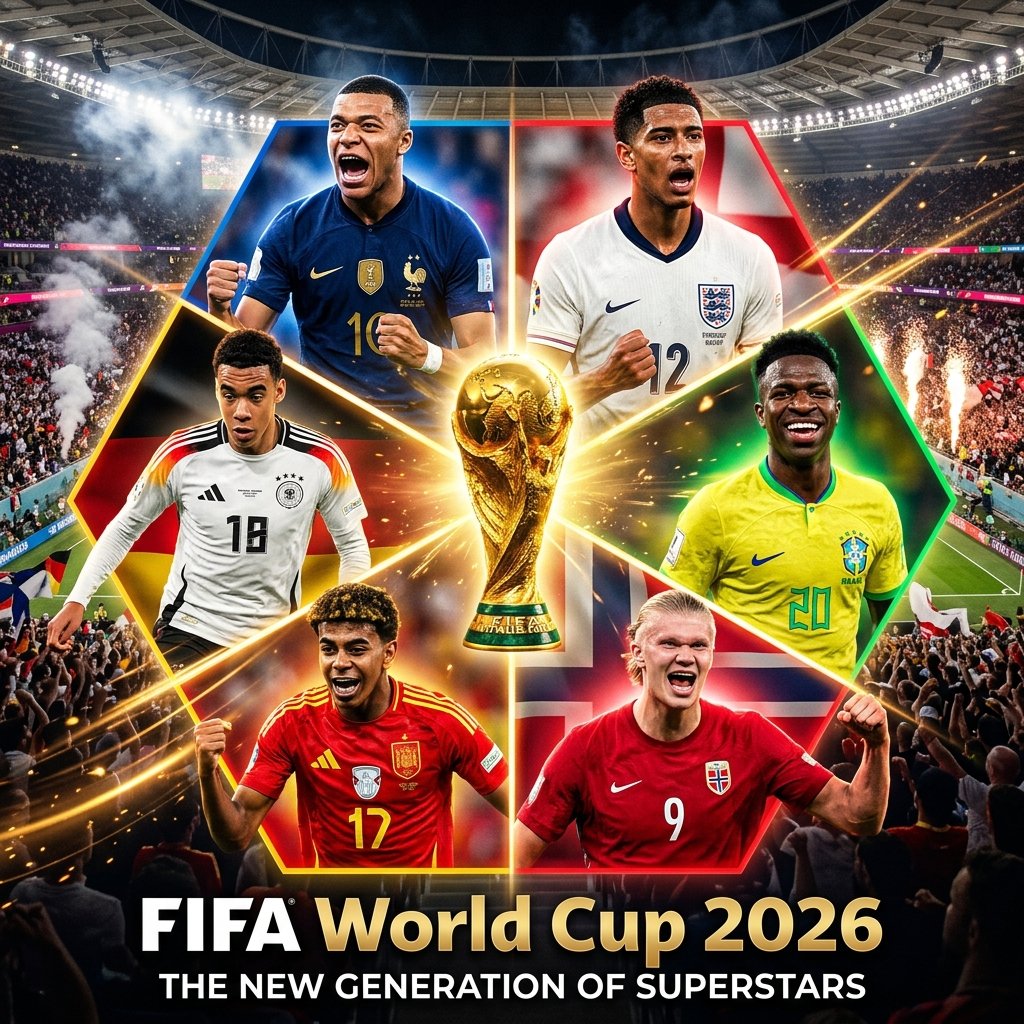
Kylian Mbappé 🇫🇷 — He was the golden generation’s promise in 2018, the heartbreak story in 2022. In 2026, Mbappé will be 27 — in the absolute prime of a generational career. This tournament could define his legacy.
Jude Bellingham 🏴 — Already one of the world’s best midfielders at just 22, Bellingham is fast becoming England’s talisman. His combination of physicality, creativity, and big-game mentality could electrify the tournament.
Vinícius Jr. 🇧🇷 — Brazil’s creative heartbeat. Vini Jr. at the Bernabéu is breathtaking — Vini Jr. at a World Cup in front of millions could be something else entirely.
Jamal Musiala 🇩🇪 — Germany’s most gifted player since Özil. At 22, Musiala is already a Bundesliga-defining talent. A World Cup on North American soil, played in prime-time for European audiences, could make him a household name worldwide.
Erling Haaland 🇳🇴 — Playing in his first-ever World Cup. The Manchester City striker has shattered every scoring record in club football. The question now is: can he translate that to the international stage? Norway in Group I will find out.
Lamine Yamal 🇪🇸 — The teenage prodigy is already rewriting records for Spain and Barcelona. By the time the FIFA World Cup 2026 arrives, Yamal will still be just 18, but his fearless dribbling, creativity, and flair have already made him one of football’s most exciting young stars. If his meteoric rise continues, the world could witness the arrival of a new global superstar on the biggest stage. The 2026 tournament may be the moment when Lamine Yamal announces himself as the future face of Spanish football.
New Nations Making Their World Cup Debut
Which Teams Are Making Their Debut in the FIFA World Cup 2026?
The expansion to 48 teams opened the door for nations that had never — or rarely — qualified before:
Curaçao 🇨🇼 — A Caribbean island with a population of around 150,000, Curaçao are the smallest nation in World Cup history. They’ll face Germany in their opening match. Extraordinary.
Uzbekistan 🇺🇿 — Central Asian football has grown enormously, and Uzbekistan’s qualification marks a milestone for the region. A nation of over 35 million with growing football infrastructure.
Jordan 🇯🇴 — Making just their second appearance (having debuted in 2014 as hosts of the AFC challenge), Jordan is a proud qualifier from Asia.
Cape Verde 🇨🇻 — The small Atlantic island archipelago qualified for the second time, continuing their remarkable football story.
The 48-team format is already doing exactly what FIFA intended — bringing football to new corners of the globe.
Continental Representation in the 2026 World Cup
How Many Teams From Each Continent Will Play in the World Cup 2026?
| Confederation | Spots | Qualified Teams |
|---|---|---|
| UEFA (Europe) | 16 | England, France, Germany, Spain, Portugal, Netherlands, Belgium, Croatia, Austria, Switzerland, Norway, Scotland, Sweden, Turkey, Bosnia & Herzegovina, Czech Republic |
| CAF (Africa) | 10 | Morocco, Senegal, Egypt, Algeria, Ghana, Ivory Coast, Cabo Verde, South Africa, Tunisia, DR Congo |
| AFC (Asia) | 8 | Japan, South Korea, Australia, Iran, Saudi Arabia, Qatar, Jordan, Uzbekistan |
| CONCACAF | 6 | USA, Mexico, Canada, Panama, Haiti, Curaçao |
| CONMEBOL (S. America) | 6 | Argentina, Brazil, Colombia, Uruguay, Ecuador, Paraguay |
| OFC (Oceania) | 1 | New Zealand |
| Inter-Confederation | 2 | Iraq, DR Congo |
Europe still leads the pack, but Africa’s 10-team allocation is a significant step up, reflecting the continent’s growing footballing talent. For the first time ever, all six confederations have at least one guaranteed berth — a genuinely historic milestone.
Early Predictions for the FIFA World Cup 2026 Knockout Stage
The group stage is fun. The knockouts are where legends are made.
Potential Round of 32 storylines to watch:
- France vs. Senegal (potential rematch) — If Group I produces a nail-biting finish, the bitterness could spill into the knockouts with a revenge narrative for France.
- Germany vs. Japan (potential) — the sequel — These two met at the 2022 World Cup, with Japan pulling off one of the tournament’s biggest shocks. A knockout rematch would be massive.
- Argentina vs. Colombia — The reigning champions vs. Copa América rivals. South American derby at a World Cup? Explosive.
Potential dark horses in the last 16:
Morocco is built for knockout football. Japan are dangerous as an underdog. Canada, on home soil, will generate an atmosphere that can carry a team. Croatia — as always — will be quietly plotting a deep run that nobody saw coming.
Realistic semifinal scenario: Spain vs. Brazil and France vs. England — or some variation of Europe’s elite colliding in the final four.
Top Players From Every World Cup 2026 Group
| Group | Team to Watch | Standout Player |
|---|---|---|
| A | South Korea | Son Heung-min |
| B | Switzerland | Granit Xhaka |
| C | Brazil | Vinícius Jr. |
| D | Turkey | Arda Güler |
| E | Germany | Jamal Musiala |
| F | Netherlands | Virgil van Dijk |
| G | Belgium | Kevin De Bruyne |
| H | Spain | Lamine Yamal |
| I | France | Kylian Mbappé |
| J | Argentina | Julián Álvarez |
| K | Portugal | Cristiano Ronaldo |
| L | England | Jude Bellingham |
Conclusion
The 2026 FIFA World Cup is unlike anything we’ve seen before. Forty-eight nations, twelve groups, three host countries, and enough star power to light up an entire continent. But while the noise was loudest around Brazil vs. Morocco and England vs. Croatia, it was Group I — quietly containing France, Senegal, Norway, and Iraq — that assembled the most treacherous collection of talent in the whole tournament.
France could very realistically finish third in that group. Erling Haaland could announce himself on the biggest stage of all. Senegal could repeat the magic of 2002. And Iraq, the last team to qualify, could play the role of the tournament’s most celebrated spoilers.
That’s the beauty of a 48-team World Cup. The chaos is baked in. The upsets are inevitable. And the Group of Death? It was hiding in plain sight.
The whistle blows on June 11, 2026. Mexico City will shake. And from there, football takes over the world.
Don’t miss a single kick.
Frequently Asked Questions (FAQs)
Which stadiums are hosting the FIFA World Cup 2026 matches?
The 2026 World Cup will be played across 16 host cities and stadiums spread over three countries. In the United States, venues include SoFi Stadium (Los Angeles), MetLife Stadium (New York/New Jersey), AT&T Stadium (Dallas), Hard Rock Stadium (Miami), Mercedes-Benz Stadium (Atlanta), Lumen Field (Seattle), Levi’s Stadium (San Francisco), Arrowhead Stadium (Kansas City), Lincoln Financial Field (Philadelphia), Gillette Stadium (Boston), and NRG Stadium (Houston). In Mexico, matches will be held at Estadio Azteca (Mexico City), Estadio Akron (Guadalajara), and Estadio BBVA (Monterrey). Canada hosts games at BMO Field (Toronto) and BC Place (Vancouver). The grand final takes place at MetLife Stadium on July 19, 2026.
How many matches will be played in total at the FIFA World Cup 2026?
The 2026 World Cup will feature a record-breaking 104 matches in total — a significant jump from the 64 matches played at the 2022 tournament in Qatar. This includes 48 group stage matches (12 groups × 3 matches each), 16 matches in the Round of 32, 8 in the Round of 16, 4 quarterfinals, 2 semifinals, one third-place playoff, and the grand final. The United States will host the majority of games, staging 78 out of the 104 total fixtures across its 11 host cities.
Can a third-placed team still qualify for the knockout stage at the 2026 World Cup?
Yes — and this is one of the most exciting rule changes in the new format. Unlike previous tournaments, where only the top two teams from each group advanced, the 2026 World Cup allows the 8 best third-place finishers across all 12 groups to also progress to the Round of 32. This means a team can finish third in their group and still have a genuine chance of going all the way to the final. It adds huge drama to the final round of group matches, where even teams that have already lost twice could technically still qualify.
Which nation has won the most FIFA World Cups heading into 2026?
Brazil hold the all-time record with 5 World Cup titles (1958, 1962, 1970, 1994, 2002), making them the most successful nation in the tournament’s history. Germany and Italy follow with 4 titles each, though Italy shockingly failed to qualify for 2026 after losing to Bosnia & Herzegovina in the UEFA playoffs. Argentina are the reigning champion after their emotional victory in Qatar 2022, giving them 3 titles alongside France. Uruguay, the inaugural winners in 1930, have 2 titles. Spain, England, and the host nation, the USA, are all still chasing their first or second World Cup crowns in 2026.
Will Lionel Messi and Cristiano Ronaldo play at the FIFA World Cup 2026?
This is the question on every football fan’s lips. Both legends will be in their late 30s by the time the tournament kicks off — Messi turns 39 in June 2026, while Ronaldo will be 41. Messi has not officially retired from international football, and Argentina’s camp has kept the door open, though his participation is far from guaranteed given his age and fitness. Ronaldo, meanwhile, has shown no signs of stopping and is expected to lead Portugal in what would almost certainly be his final World Cup appearance. If both play, it could mark the last chapter of the greatest individual rivalry football has ever seen — a fitting farewell on the sport’s biggest stage.

I’m a football writer, covering top leagues like the Premier League, La Liga, Bundesliga, Serie A, and Ligue 1. I write about match analysis, football news, tactics, and major tournaments such as the FIFA World Cup, delivering clear, engaging insights for fans.
About The Author